
Written by Bobby Cole, Music Rights Strategist with over 20 years’ experience helping independent artists protect, manage and monetise their music rights.
Releasing a song is one of the most rewarding moments in an artist’s journey.
After weeks or months of writing, recording and refining every detail, your attention shifts to release day. You’re thinking about artwork, playlists, promotion and finally letting people hear what you’ve created.
That’s usually when ownership gets pushed into the background.
Not because artists don’t care about their rights, but because ownership feels like administration. It feels like something that can wait until after the music is live.
The problem is that many of the ownership decisions that shape your future have already been made.
Who owns the song?
Who owns the master recording?
Has everyone agreed what they own?
Most artists don’t ask those questions while they’re creating because nothing feels wrong.
They ask them later, when a royalty payment doesn’t look right, a collaborator questions their share, or a licensing opportunity depends on knowing exactly who owns the rights.
By then, the easiest time to make those decisions has already passed.
This guide is about helping you make the right ownership decisions while they’re still easy to make.
Quick Answer
Who owns a song?
A song can have more than one owner. The composition (the lyrics and melody) and the master recording are separate rights, and ownership depends on who contributed to creating them and what was agreed along the way. Understanding those decisions before release is one of the simplest ways to protect your music, your royalties and your future opportunities.
One of the reasons music ownership feels confusing is that no single system manages every part of it. Understanding who owns what is one challenge. Keeping that information organised across the life of a song is another.
Mistake #1
Writing the Song Doesn’t Mean You Own Everything
Most ownership mistakes begin with an assumption. That if they wrote the song, paid for the recording and released it themselves, they automatically own everything connected to it.
You’ve invested the time, the money and the creative energy, so it’s easy to see why many artists think they own every part of the finished release.
That assumption starts to change the moment someone else makes a meaningful creative contribution. A co-writer, producer, beatmaker or featured artist can all change the ownership conversation in different ways.
That’s why one of the first questions during a licensing opportunity is surprisingly simple:
“Who owns the rights?”
If everyone gives the same answer, the conversation moves forward. If they don’t, everything stops until ownership is clear.
You don’t need to understand every detail of music copyright, just one important point.
Writing the song doesn’t automatically mean you own everything connected to it.
Mistake #2
You Can’t Protect Rights You Don’t Understand
Before you can protect your music, you need to know what you’re actually protecting.
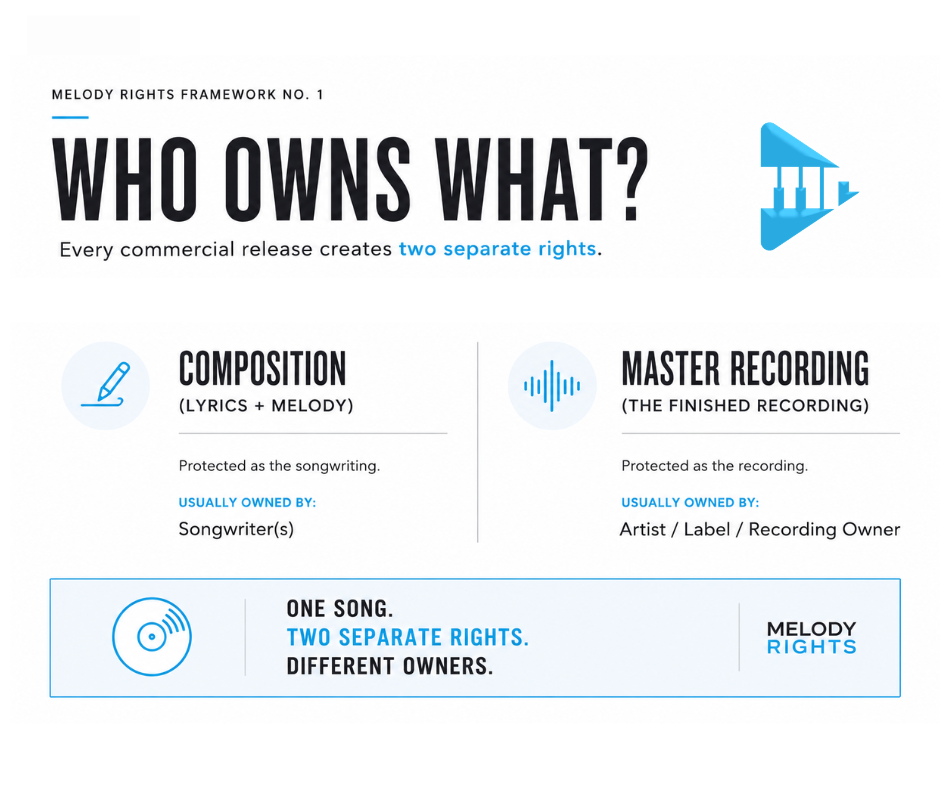
Most artists think of a song as one piece of work. Legally, every commercial release creates separate rights that can have different owners.
Every commercial release creates two main rights.
- The first protects the composition: the lyrics, melody and musical structure.
- The second protects the master recording: the finished recording people hear on streaming platforms, radio and everywhere else your music is played.
That’s why understanding the difference matters before release, not afterwards.
If someone else helped shape the song or recording, make sure everyone understands what they own before moving forward. It’s a much easier conversation while the music is still being created than months after it’s been released.
Songwriters in the UK typically register their musical works with organisations such as PRS for Music to help collect performance royalties and manage their rights.
Ownership Decision
Before moving on, ask yourself:
- Who owns the composition?
- Who owns the master recording?
- Would everyone involved in this song give the same answer?
If you’re unsure about any of them, that’s the conversation to have before release.
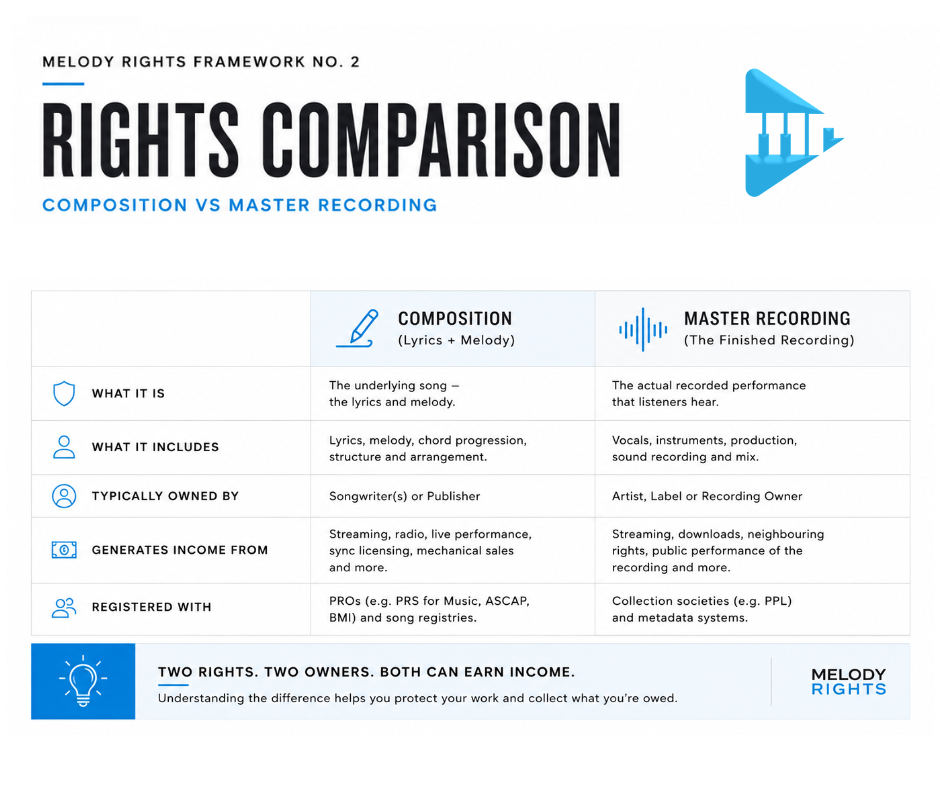
Melody Rights Framework No. 2
Rights Comparison
Mistake #3
Every New Collaborator Changes the Ownership Conversation
Collaboration often makes a song stronger. It also introduces new ownership conversations.
A co-writer, producer, beatmaker or featured artist may all contribute in different ways. Some contributions may affect ownership. Others may simply be paid work.
The mistake isn’t collaborating. It’s assuming everyone leaves the session with the same understanding of who owns what.
Most disagreements begin with different expectations, not bad intentions.
Mistake #4
Leaving Split Sheets Until Later
Once the session is over, it’s tempting to say you’ll sort the paperwork out another day.
People remember writing sessions differently. Ideas that felt obvious at the time become harder to untangle months later.
A split sheet isn’t about expecting an argument.
It’s about making sure everyone leaves with the same understanding of what was agreed.
Ownership Decision
Before leaving the session, ask yourself:
- Have we agreed the songwriting splits?
- Has everyone seen and accepted them?
- Is that agreement recorded somewhere everyone can access?
Mistake #5
Assuming the Master Recording Automatically Belongs to You
Owning the song and owning the recording aren’t always the same thing.
If you paid for the recording yourself and stayed in control throughout the project, you may well own the master recording.
If someone else funded it, produced it under different terms or another agreement exists, the answer may not be as straightforward.
Many artists don’t realise there’s a difference until someone asks for permission to licence the recording.
If someone wants to licence your recording, the last thing you want is uncertainty over who has the authority to say yes.
Knowing the answer before release makes future opportunities much easier to deal with.
Mistake #6
Thinking Your Distributor Protects Your Rights
By this stage, your song is ready to go.
You’ve uploaded the audio, added the artwork, chosen a release date and clicked through the final checks.
It feels like the hard work is over.
But uploading your music doesn’t confirm who owns it.
A distributor delivers your music to streaming platforms. It doesn’t decide who owns the composition, who owns the master recording or how ownership should be divided between collaborators.
Those conversations should already be finished before you upload your release.
If you’re unsure where a distributor’s role begins and ends, read our guide to Do Distributors Collect Publishing Royalties?
Mistake #7
Treating Metadata Like Admin Instead of Ownership
Once the creative work is finished, entering names, codes and credits is probably the last thing you want to do. It’s also one of the easiest places to make a costly mistake.
Metadata tells the music industry who created your song and who should be connected to it.
If you’re unsure what information should be included, our guide to protecting your music explains how metadata, copyright and registrations all work together. How to Protect Your Music: 2025 Artist’s Guide
A misspelled name or missing songwriter credit can make it much harder to match your music with the people who should be paid.
Treat metadata as part of protecting your music, not something to rush through five minutes before release.
Ownership Decision
Before clicking publish, ask yourself:
- Are all contributors credited correctly?
- Has your metadata been checked for mistakes?
- Could someone else identify who owns this song from the information you’ve provided?
Mistake #8
Assuming Royalties Will Sort Themselves Out
Royalties only flow as smoothly as the ownership behind them.
If ownership isn’t clear, neither is the path your royalties need to take. You don’t need to understand every royalty before releasing your music.
Getting ownership right early gives every royalty a better chance of reaching the right person.
We’ll explain the different royalty types in more detail in our guide to The 4 Types of Music Royalties Explained, including who collects them and why artists often miss part of their income.
Mistake #9
Waiting Until an Opportunity Arrives to Check Ownership
Who owns the rights?
One thing we’ve learned after helping independent artists is that opportunities don’t create ownership problems. They expose the ones that were never resolved.
The artists who move quickly aren’t always the most successful.
They’re the ones who already know who owns the composition, who owns the master recording and who can approve the opportunity without stopping to untangle ownership first.
They’re usually the ones who already know who owns the composition, who owns the master recording and who has the authority to say yes.
The master recording also generates its own income streams, which are collected separately from songwriting royalties. In the UK, performers and recording rightsholders typically work with organisations such as PPL.
Real-world example: Uptown Funk
When Uptown Funk became a global hit, additional songwriters were later credited following claims that elements of earlier songs had been incorporated. As the song’s success grew, its ownership came under much closer scrutiny.
Most independent artists will never face that level of attention, but the lesson is the same. The more valuable a song becomes, the more important it is to know exactly who owns what before opportunities arrive.
If sync is one of the opportunities you’re working towards, make sure your ownership is clear before you start pitching. Our guide on submitting music for film and TV without losing your rights walks through the process.
Independent artists are unlikely to face the same level of scrutiny, but the lesson is the same. The more valuable a song becomes, the more important it is to know exactly who owns what.
Mistake #10
Thinking Music Ownership Lives in One Place
One of the biggest misconceptions in music is that ownership is stored in a single database. It isn’t.
Ownership starts with the agreements you make while creating the song. Those decisions are then reflected across different documents, registrations and organisations depending on the type of right. If one part is missing or inconsistent, it can affect royalties, licensing and future opportunities.
| Ownership decision | First recorded in | Later reflected in |
| Songwriting splits | Split sheet | PRO registration |
| Master ownership | Agreement/contract | Label or distributor records where relevant |
| Song metadata | Distributor upload | Streaming platform metadata |
| ISRC | Assigned by rights holder/distributor | Embedded in release |
| Publishing | Publishing agreement or self-administration | Publisher/PRO records |
This is exactly why music ownership feels so overwhelming.
You’re expected to keep track of different agreements, registrations and organisations throughout the life of a song, with no single place bringing it all together.
That’s one of the problems Melody Rights was created to solve, helping independent artists organise the information behind every release so ownership stays clear from the first writing session to the first royalty payment.
Before You Release Your Next Song
Ownership Health Check
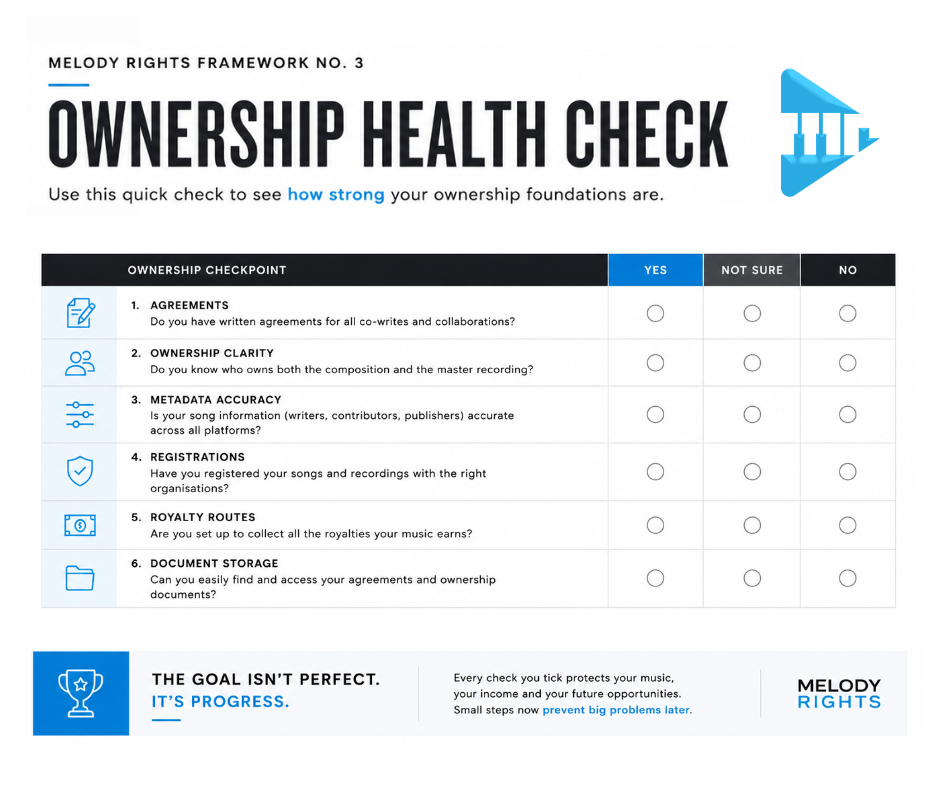
Before you release your next song, spend two minutes working through this checklist.
If you answer No to any question, resolve it before your music goes live.
Ownership Checklist
☐ I know who owns the composition.
☐ I know who owns the master recording.
☐ Everyone understands what they contributed.
☐ Songwriting splits have been agreed.
☐ Those agreements have been recorded.
☐ Every contributor has been credited correctly.
☐ My metadata has been checked.
☐ I know who collects each royalty.
☐ I could prove ownership if someone asked today.
☐ Everyone involved would give the same answer about who owns the song.
Melody Rights Framework No. 3
Ownership Health Check
If you’ve worked through this checklist and realised there are gaps, don’t worry.
Most ownership mistakes can be resolved before they become bigger problems.
Melody Rights helps you organise the information behind your music, keep track of important ownership decisions and stay on top of the registrations that support your rights and royalties as your catalogue grows.
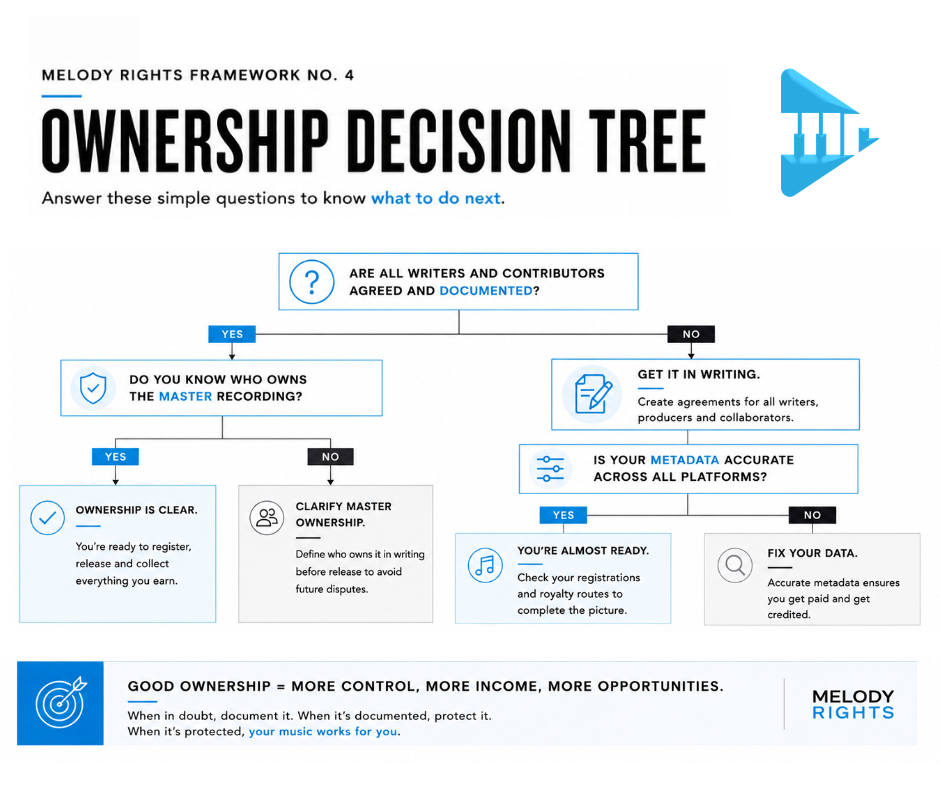
The Melody Rights Ownership Decision Tree
Every release follows the same journey.
Instead of asking whether your song is ready, ask whether your ownership is.
Melody Rights Framework No. 4
Ownership Decision Tree
Not sure whether you’re ready to release? Follow the Melody Rights Ownership Decision Tree below. It takes less than a minute and helps you spot the ownership conversations worth having before your music goes live.
Frequently Asked Questions
Who owns a song?
A song can have more than one owner. The composition and the master recording are separate rights, and ownership depends on who contributed to creating them and what was agreed during the creative process.
Who owns the rights to a song?
Different rights can belong to different people. Songwriters usually own rights in the composition, while ownership of the master recording depends on who created, funded or agreed ownership of the recording.
Do I own my music if I upload it to Spotify?
No. Uploading music doesn’t determine ownership. Your distributor delivers your music to streaming platforms, but ownership is decided by the agreements made before release.
Can two people own the same song?
Yes. Co-written songs are commonly owned by more than one songwriter. Agreeing those ownership shares before release helps prevent disputes later.
Does my producer automatically own part of my song?
Not necessarily. It depends on the contribution they made and any agreement between you. Never assume. Always discuss it.
Can ownership change after release?
Yes. Rights can be transferred or licensed, but it’s much easier to establish clear ownership before your music is released.
Final Thoughts
Every song starts as an idea.
By the time it’s released, it has usually become much more than that. New collaborators have contributed, decisions have been made and opportunities are beginning to take shape. Along the way, ownership has been defined, whether you realised it or not.
The artists who stay in control aren’t the ones who know every copyright law by heart.
They’re the ones who ask the right questions early, record important decisions while everyone agrees and keep that information organised as their catalogue grows.
That’s where Melody Rights fits in.
It gives independent artists one place to organise ownership information, registrations and the rights administration behind every release, so when royalties arrive, collaborators have questions or a licensing opportunity comes along, the answers are already there.
Because protecting your music isn’t just about knowing who owns it.
It’s about being able to prove it, whenever it matters.