
Written by Bobby Cole, Music Rights Strategist with 25+ years of experience in sync licensing, publishing, royalty systems and independent artist development.
You have written the song, paid for the recording, and finally found someone who can turn the idea in your head into a record that actually sounds the way you imagined.
Then comes the conversation about money.
“I want 20%.”
Twenty percent of what?
That question matters far more than the number itself. A producer fee, master royalty, songwriting share, publishing interest and ownership of the master are different things, yet they are often thrown into the same conversation as if they were interchangeable.
A good producer can transform a record and be worth every penny. A poorly understood deal can also leave an artist giving away income or rights for years without fully understanding what they agreed to.
So, before you agree to a percentage, it is worth asking a more useful question: what is the producer actually bringing to the record, and what are you giving them in return?
What Does a Music Producer Actually Do?
The word “producer” covers a surprisingly wide range of jobs.
A producer might help shape the arrangement, choose sounds, coach performances, organise musicians, work with engineers, solve recording problems, manage the session or make the creative decisions that turn a rough song into a finished record. Berklee describes producers as creative partners whose involvement can begin before recording and continue through the final stages of a project. Berklee: Music Producer
That means the value of a producer isn’t simply knowing how to use music-production software.
A great producer can hear that the second verse is too long, recognise that the vocal performance needs another take, strip away an arrangement that is getting in the way of the song, or push an artist towards something they would not have found alone.
For an independent artist, that objectivity can be extremely valuable.
Do Independent Artists Actually Need a Producer?
No, not necessarily. You can absolutely make successful music without hiring an outside producer.
Modern production software, home studios, affordable recording equipment and online education have made it much easier for artists to develop production skills themselves. The songwriter-producer has become a perfectly viable creative model, with the artist taking responsibility for both the songwriting and the production of the recording.
The better question is whether you should be the producer of your own music.
Self-production can make sense if you already have strong production skills, enjoy the technical side of recording and have enough time to become genuinely good at it. An artist with a very specific sound may also find that self-production gives them more control.
Hiring a producer can make more sense when you are a strong songwriter but struggle with arrangement, recording or finishing songs, or when you know what you want the record to feel like but cannot quite get there yourself.
You are not paying a producer simply because they have the title. You are paying for the skills, judgement, time and perspective you do not currently have.
Is the Producer Actually Adding Enough Value?
This is the part artists should think about before talking percentages.
Ask yourself:
| Question | What you are really assessing |
| Did they materially improve the record? | Creative value |
| Did they change the arrangement or musical direction? | Creative contribution |
| Did they bring skills you do not have? | Technical value |
| Did they help capture better performances? | Production value |
| Did they save you significant time or money? | Practical value |
| Did they contribute original musical ideas? | Possible songwriting contribution |
| Did their network or resources materially help? | Additional leverage |
The more substantial the contribution, the stronger the argument for meaningful compensation.
But compensation and ownership are not the same decision.
A producer can be hugely valuable without automatically owning part of every right connected to the recording.
When a Producer Says “I Want 20%”, Ask: 20% of What?
This is where things can get messy very quickly.
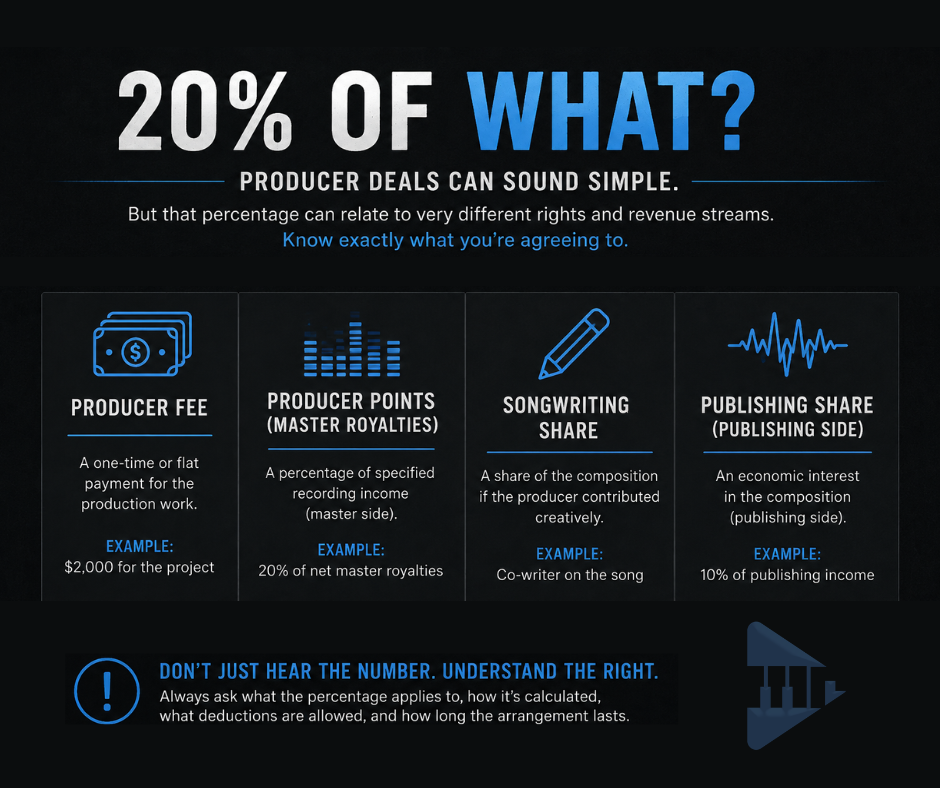
| Arrangement | What it may relate to |
| Producer fee | Payment for the production work |
| Producer points | A percentage of specified recording income |
| Songwriting share | A share of the composition where the producer contributed creatively |
| Publishing share | An economic interest connected to the composition |
| Master ownership | Ownership of the sound recording itself |
Those rights can sit with different people.
Melody Rights already explains the difference between the composition and the master recording in its guide to master royalties and publishing royalties, which is worth reading before agreeing to any deal involving both sides of the music.
The important point is that “20%” tells you almost nothing until you know what the percentage applies to, how the money is calculated, what deductions are allowed and how long the arrangement lasts.
The Musicians’ Union’s current specimen production agreement is a useful illustration of why this matters. Its example deals with income, expenses, royalties, accounting and ownership as separate contractual questions rather than simply stating one headline percentage.
Producer Fee vs Points vs Publishing vs Master Ownership
A producer fee, master royalty, songwriting or publishing share, and master ownership are not the same thing. They can give the producer very different economic rights, so it is worth separating them before agreeing to a deal.
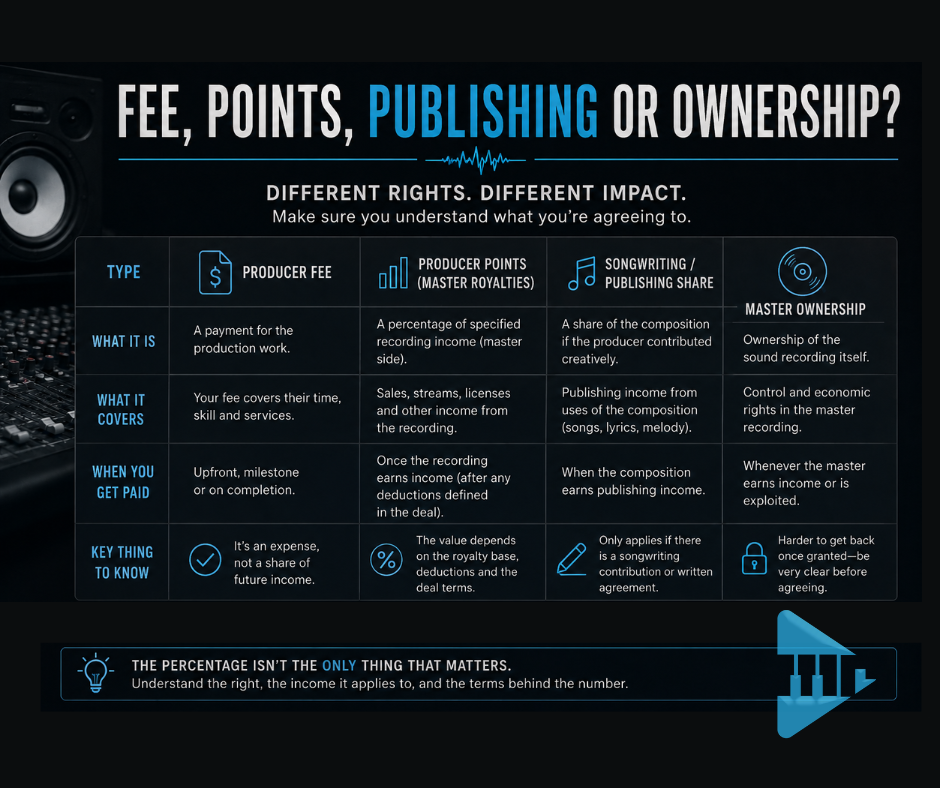
Description: Graphic comparing the four main types of producer compensation and ownership in music.
Producer fee
This is payment for the production work itself.
Producer points / master royalty
This gives the producer a percentage of specified income from the recording, depending on the agreement. The royalty base, deductions and payment terms all matter.
Songwriting share
This relates to the underlying composition. If a producer contributes original musical or lyrical material, they may be entitled to a songwriting share. Producing a recording does not automatically make someone a songwriter or give them publishing rights.
Master ownership
This concerns ownership or control of the actual sound recording. It is a separate question from who wrote the song and who receives publishing income.
What Are Producer Royalties and Points?
Producer royalties, often called producer points, are a percentage of income from a recording that a producer receives under their agreement with the artist or rights holder. The exact percentage and the income it applies to depend on the deal, so there is no universal rate that is automatically fair.
The right deal depends on what the producer contributed, whether they were already paid a fee, whether they helped write the composition, what they are being asked to do after recording, and what rights they want to retain.
In some recording deals, producer royalties are discussed in the low single digits, often around 3% to 5% of the relevant master royalty base. But that is an industry convention, not a universal rate, and independent deals can be structured very differently. Notes.fm: Producer Royalties
The number only makes sense when you know what the producer is receiving alongside it.
A producer who creates a substantial part of the music may have a strong argument for songwriting participation. A producer who is providing production services on an already-written song may have a very different arrangement.
Likewise, a master royalty is not the same thing as owning part of the master.
That is why “industry standard” should never be the end of the conversation. If somebody tells you a percentage is standard, ask them to explain standard for what kind of deal, covering which right and calculated against which income.
The current Musicians’ Union guidance also warns artists to examine production agreements carefully, particularly where ownership of recordings, publishing or other income streams is involved.
Is a 50/50 Producer Split Ever Fair?
It can be.
If a producer has effectively co-created the record, contributed substantial songwriting, built the instrumental, shaped the arrangement and brought a large part of the creative work to the finished track, a significant share may be entirely reasonable.
But 50% is not automatically fair because someone is called a producer.
If the artist wrote the song, paid for the session and supplied the creative direction while the producer made relatively limited production changes, the same percentage may look very different.
The question is not whether 50/50 sounds generous or greedy.
The question is whether the deal reflects the contribution and clearly identifies what each person is actually receiving.
What Are Artists and Producers Arguing About in the Real World?
This confusion is not just theoretical.
In recent music-business discussions, producers have described trying to work out arrangements involving upfront fees, publishing shares and master percentages, while still being unsure how the different royalty systems fit together. Other producers have debated whether a custom production fee should come with additional master or publishing participation.
A real-world question artists are asking
“If a producer gets 10%, and I’ve already paid a $1,000 fee, how does that actually work?”
That is the kind of question appearing in current music-business discussions, where independent producers are trying to understand how producer points, upfront fees and recoupment interact. Reddit discussion: Recoupable Producer Points
Why this matters: “10%” doesn’t tell you enough. You still need to know what the percentage applies to, whether it is recoupable, what income is included, and who is responsible for accounting and payment.
These conversations are not industry authority, and Reddit is not a substitute for a contract or professional advice. They are useful for a different reason: they show how easily working musicians can use the word “royalties” while meaning completely different things.
That is exactly why artists should slow the conversation down before signing anything.
Can You Make a Successful Record Without an External Producer?
Yes, but there is an important catch.
You have not removed the production role. You have taken it on yourself.
Kevin Parker is a useful example of an artist who developed enough production skill to take substantial creative control over his own recordings. His work with Tame Impala shows what can happen when the artist becomes deeply involved in both the songwriting and production of the record.
The lesson is not that successful artists do not need production expertise.
The lesson is that some artists become sufficiently skilled at production that they become the producer.
Self-production also does not mean doing absolutely everything alone. An artist can self-produce and still bring in a mixing engineer, mastering engineer, session musician or specialist collaborator when the project needs one.
If you are considering going it alone, ask yourself whether you genuinely want to spend the time becoming good at another profession. Saving a producer’s percentage is not much of a saving if you spend two years making records that are never finished.
Has Technology Made Producers Obsolete?
It has changed the job, but I would not say it has made good producers obsolete.
Home studios, DAWs, sample libraries, remote collaboration, online education and increasingly capable AI tools have removed many of the technical barriers that once made professional recording much harder to access.
Producers have historically provided another kind of access too. The right producer could connect an artist to studios, musicians, engineers, labels and other industry relationships that were difficult to reach independently.
That gatekeeping role is weaker now because artists can build audiences, collaborate remotely and release music without waiting for someone to open the door. It does not make the producer irrelevant, though. It shifts the value towards creative judgement, taste and the ability to make a record better.
What technology cannot automatically give an artist is taste.
Someone still has to decide which idea is worth keeping, when the chorus should arrive, whether the vocal performance has the right emotion, what needs removing and whether the finished record actually sounds like the artist.
That may become the producer’s most valuable role in the future.
The technical barrier is getting lower. Creative judgement is a different problem.
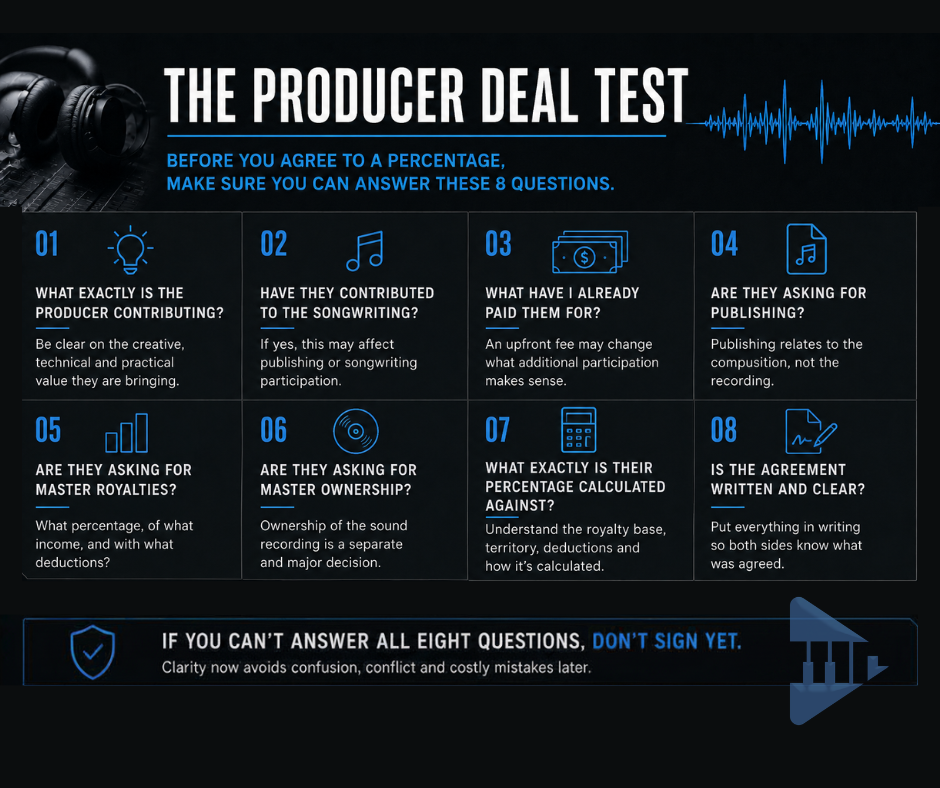
The Producer Deal Test
Before agreeing to a producer percentage, make sure you can answer these questions:
- What exactly is the producer contributing?
- Have they contributed to the songwriting?
- What have I already paid them for?
- Are they asking for publishing?
- Are they asking for master royalties?
- Are they asking for master ownership?
- What exactly is their percentage calculated against?
- Is the agreement written down clearly?
If you cannot answer those questions, you are not ready to negotiate the percentage.
And once you have agreed the deal, the job is not finished. Your ownership information, contributor details, metadata and registrations need to remain consistent as the song moves into release and royalty collection. Melody Rights’ guide to who owns a song and the ownership mistakes artists commonly make goes deeper into that process.
Where Melody Rights Fits In
A producer agreement tells you who gets what.
The next problem is keeping that information organised.
If you are working with producers, co-writers and other collaborators, the details behind each song can quickly spread across contracts, split agreements, registrations, metadata and royalty systems. Melody Rights is designed to help independent artists keep that rights information organised as their catalogue grows.
Once the deal is agreed, those contributor details and splits also need to be reflected correctly when the track is registered. Our guide to how to register your music and get paid walks through that process.
That means when a royalty statement arrives, a collaborator asks about their share or a licensing opportunity appears, you are not trying to reconstruct the history of the song from old emails and messages.
You already know what was agreed.
Got the producer deal sorted? Now make sure the rights behind the song stay under control.
Melody Rights helps independent artists keep track of contributors, registrations, metadata and royalties across their catalogue, so the agreement you made in the studio does not disappear into a folder full of old emails.
Explore Melody Rights and keep your music rights in order.
Frequently Asked Questions
Do independent artists need a music producer?
No. Artists can self-produce successfully, particularly when they have developed strong production skills. An external producer becomes valuable when their creative judgement, technical ability or experience can materially improve the recording.
How much should a music producer get?
There is no universal fair percentage. The deal depends on the producer’s contribution, any upfront fee, songwriting involvement, master-side participation and the exact income the percentage applies to.
Do producers get publishing royalties?
A producer does not automatically receive publishing simply because they produced a recording. Publishing participation can arise when a producer makes a qualifying songwriting contribution or where the parties agree an arrangement that gives them a share.
Do producers own the master?
Not automatically. Master ownership depends on the agreements surrounding the recording. Production services, master royalties and master ownership are separate questions that should be clearly documented.
Is a 50/50 producer split fair?
It can be, but there is no universal rule. A substantial co-creative contribution may justify significant participation, while a limited production contribution may not. The percentage needs to be considered alongside the rights and income it actually covers.
Final Thought
A great producer can be worth far more than their percentage.
They can save an artist years of learning, hear problems the artist can no longer hear, improve the arrangement, pull a better performance out of a session and turn a promising song into a record people actually want to hear.
But an artist should never give away a percentage simply because someone says, “That’s what producers get.”
Know what they are contributing. Know which right you are giving away. Know how the percentage is calculated. Put the agreement in writing, then keep the information behind that agreement organised.
The best producer relationship should leave both people feeling that the deal makes sense.
And if the record becomes successful, neither side should have to guess what they agreed to.