
Quick Answer
Distribution platforms primarily collect royalties connected to the sound recordings they deliver to streaming services. While some offer additional collection services, distribution alone does not usually cover every royalty your music generates. Publishing royalties, neighbouring rights, live performance income, and sync opportunities are often managed through separate systems.
The Confusion Usually Starts With One Simple Question
Many independent artists don’t discover the royalty gap until somebody asks them a simple question:
“Who’s collecting your publishing royalties?”
That’s usually the moment the confusion starts.
The artist knows their music is on Spotify. They know their distributor pays royalties. They may even have money arriving every month.
So naturally the next question is:
“Isn’t my distributor already doing all of that?” – It’s a fair assumption.
Most artists spend years learning how to release music. Far fewer spend time learning how money moves after release. That’s where things start to get messy.
If you’re new to music royalties, our guide to How Do Musicians Make Money? explains the main income streams available to independent artists.
Why Don’t Distribution Platforms Collect All Royalties?
Distribution platforms are designed to solve one problem. – Getting your music onto streaming services and digital stores.
When you upload music through a distributor, they deliver your recordings to platforms like Spotify, Apple Music, Amazon Music, YouTube Music, and TikTok. They then collect the income generated by those recordings and pass it back to you according to their terms.
That’s an important job. But it isn’t the entire music rights ecosystem.
Your music can generate multiple types of royalties, and many of them are collected through completely different systems.
This isn’t unique to DistroKid, TuneCore, CD Baby, or any particular distributor. It’s simply how the music industry works.
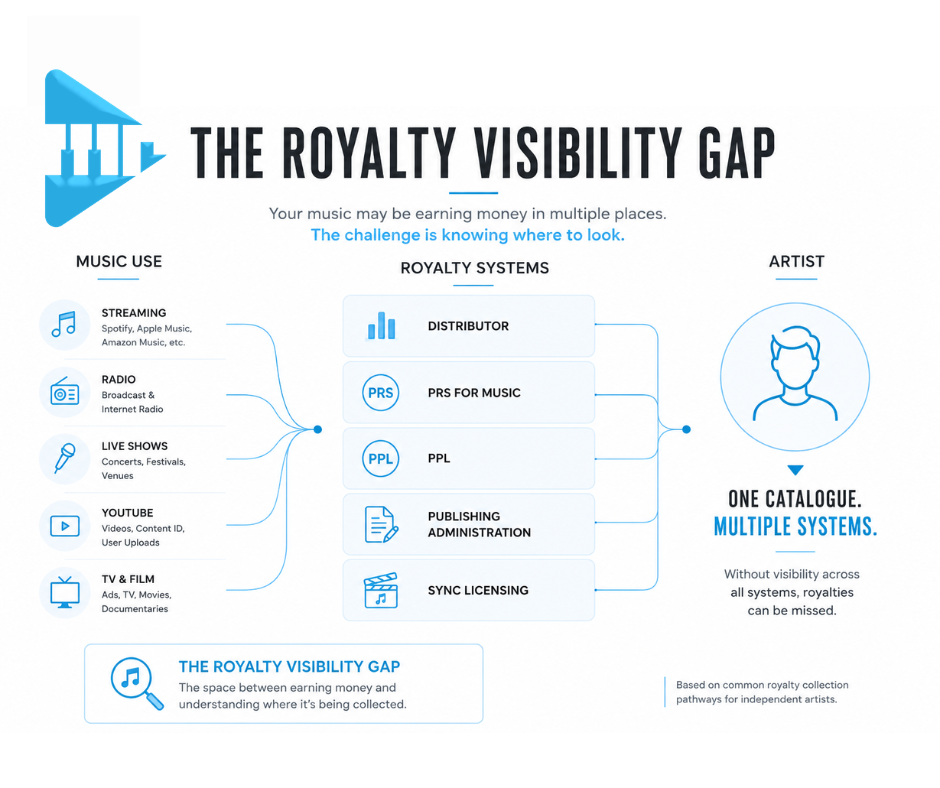
The Royalty Visibility Gap
At Melody Rights, we see the same confusion repeatedly.
Artists assume the challenge is getting paid.
In reality, the challenge is often understanding where money should be coming from in the first place.
We call this the Royalty Visibility Gap.
It’s the space between earning money and understanding where that money is being collected. Most artists can see the royalties arriving through their distributor dashboard.
What they can’t always see are the royalties being tracked, registered, collected, or missed elsewhere.
That gap becomes larger as a career grows.
More releases.
More performances.
More territories.
More platforms.
More places where money can end up.
The Royalty Gap Most Artists Don’t Know Exists
Imagine your song starts gaining traction.
People stream it on Spotify.
A local radio station plays it.
You perform it at a festival.
A venue uses it before a show.
Someone adds it to a YouTube video.
From an artist’s perspective, it’s all the same song.
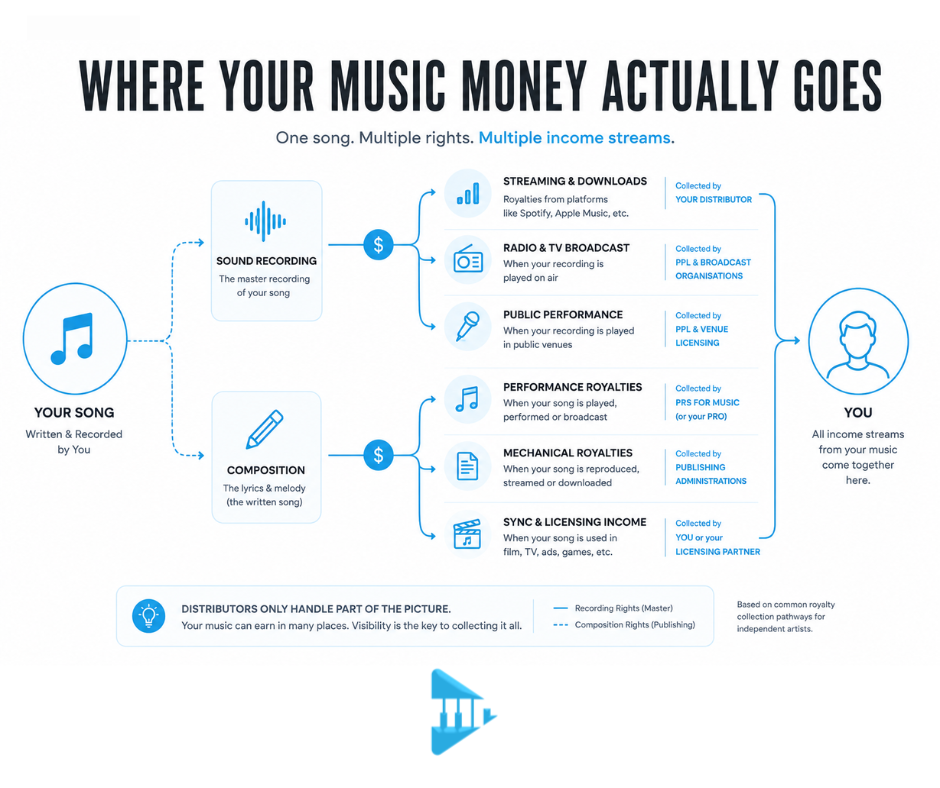
Legally, though, every song contains two separate assets: the recording and the composition.
Both can generate income.
Both can generate different royalty streams.
Both may be collected differently.
If you’re unfamiliar with that distinction, our guide to Master Royalties vs Publishing Royalties explains how those rights work.
Some of those payments may reach your distributor. Others may not.
That’s where many artists discover there was more money connected to their music than they realised.
The Four Layers Of Music Income
One reason artists get confused is because different parts of the industry handle different jobs.
Thinking about music income in layers makes it easier to understand.
| Layer | Purpose |
| Distribution | Gets music onto platforms |
| Collection | Collects royalties generated by usage |
| Administration | Registers rights and ownership |
| Licensing | Creates additional income opportunities through sync and commercial use |
Most distributors focus on the first layer. Many artists don’t realise the other layers exist until much later.
Which Royalties Does A Distributor Collect?
Most distributors collect royalties connected to the sound recording itself.
If you’re unfamiliar with the categories below, read our guide to The 4 Types of Music Royalties Explained for a deeper breakdown.
| Royalty Type | Usually Collected By |
| Streaming royalties | Distributor |
| Download royalties | Distributor |
| Performance royalties for songwriters | PROs |
| Mechanical royalties | Publishing administrators or collection societies |
| Neighbouring rights | PPL and equivalent organisations |
| Live performance royalties | PROs |
| Sync fees | Rights holders or licensing partners |
The exact services vary between distributors, and some offer additional collection options. The important point is that distribution and rights administration are separate jobs.
Distributor vs Publisher: What’s the Difference?
One reason artists get confused is because distributors and publishers are often mentioned in the same conversation.
They both help musicians earn money, but they do very different jobs.
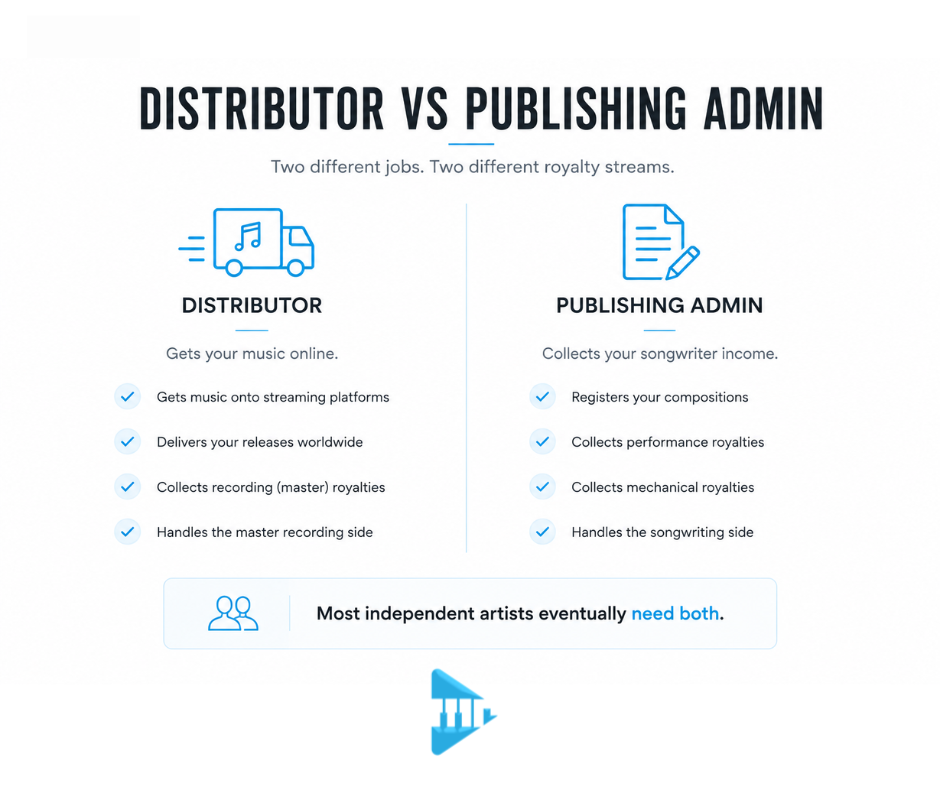
A distributor focuses on the recording. Their role is to get your music onto platforms like Spotify, Apple Music, and Amazon Music, then collect royalties connected to those recordings.
A publisher focuses on the song itself. They help register compositions, collect publishing royalties, and manage the rights connected to songwriting.
If you’ve written and recorded your own music, both sides matter. One helps people hear your music. The other helps make sure the songwriting income is being collected properly.
That’s why many independent artists eventually discover they need more than just distribution.
The confusion doesn’t stop there. Many artists then discover that publishers and publishing administrators aren’t necessarily the same thing either.
Distributor vs Publishing Administrator
This is one of the most common areas of confusion for independent artists.
| Task | Distributor | Publishing Administrator |
| Deliver music to Spotify | ✓ | ✗ |
| Collect streaming royalties | ✓ | ✗ |
| Register compositions | ✗ | ✓ |
| Collect publishing royalties | ✗ | ✓ |
| Collect mechanical royalties | ✗ | ✓ |
| Assist with sync opportunities | Sometimes | Sometimes |
Many artists spend years understanding distribution before they realise publishing administration is an entirely separate part of the business.
Our guide to What Are Music Publishers? explains this in more detail.
Why Money Gets Left Behind
Most missing royalties aren’t the result of anything suspicious.
They’re usually the result of fragmented systems.
Different rights, different organisations, different registrations, different databases.
The music industry wasn’t built as one connected platform, it evolved over decades.
As a result, your music can earn money in multiple places at the same time.If you’re only connected to one of those places, you’re only seeing one part of the picture.
Many of these unmatched payments eventually become unclaimed royalties, sometimes referred to as black box royalties.
We explore this further in How to Make Money from Music Online where we look at how royalties get lost and how artists can improve collection.
A Common Artist Scenario
An artist releases a song through a distributor.
A few months later they receive streaming royalties. – Everything appears to be working.
Then somebody asks whether they’re registered with PRS. Or whether they’re collecting neighbouring rights through PPL. Or whether their publishing is being administered.
Suddenly the artist realises they weren’t missing streams. They were missing visibility.
The money wasn’t necessarily gone. They simply didn’t know where to look.
That’s a very different problem.
Who Collects The Royalties Your Distributor Doesn’t?
In the UK, songwriter royalties are commonly collected through PRS for Music, which tracks and pays performance royalties when music is streamed, broadcast, or performed publicly.
Performers and recording owners may also be entitled to neighbouring rights royalties through PPL when recordings are broadcast or played in public.
These organisations exist alongside distributors, not instead of them.
That’s why many artists eventually discover they need more than a release platform if they want a complete picture of their music income.
The Real Problem Isn’t Distribution
This is where most conversations about royalties miss the point.
The problem isn’t usually distribution. Most distributors do exactly what they’re supposed to do.
The problem is fragmentation.
Streaming income may appear in one dashboard. Publishing royalties in another. Neighbouring rights somewhere else. Sync opportunities in a completely different place.
The more your catalogue grows, the harder it becomes to understand what your music is earning as a whole.
For many artists, the challenge isn’t collecting royalties.
It’s knowing which royalties are being collected, where they’re being collected, and whether anything is being missed.
That’s the real visibility gap.
Before You Assume You’re Collecting Everything
Use this checklist as a quick audit.
- Is your music distributed?
- Are your compositions registered?
- Are your writer splits recorded?
- Are your ISRCs accurate?
- Are you registered with PRS?
- Are you registered with PPL?
- Are neighbouring rights being collected?
- Are mechanical royalties being collected?
- Is your metadata complete and accurate?
Most artists can answer some of these questions.
Far fewer can answer all of them.
The Bigger Picture
Distributors are valuable.
They solve a real problem and make music available worldwide with a few clicks. The mistake isn’t using a distributor.
The mistake is assuming distribution and royalty collection mean the same thing. They don’t. Getting your music online is the beginning of the journey.
Understanding what your catalogue is earning, where it’s earning it, and whether anything is being missed is a completely different challenge.
Most platforms focus on one part of the process.
Distribution.
Publishing.
Neighbouring rights.
Sync.
The challenge for artists is understanding how those pieces connect. That’s where visibility becomes just as important as collection.
FAQ
Does a music distributor collect publishing royalties?
Usually not. Most distributors focus on royalties generated by the sound recording. Publishing royalties are typically collected through publishers, publishing administrators, or collection societies.
Do I need PRS if I use DistroKid?
DistroKid and PRS perform different roles. DistroKid distributes recordings, while PRS collects songwriter performance royalties. Many artists use both.
What’s the difference between a distributor and a publisher?
A distributor delivers recordings to streaming platforms. A publisher or publishing administrator manages the composition side of your music and helps collect publishing royalties.
Why am I missing royalties from Spotify?
In many cases, artists aren’t missing Spotify royalties. They’re missing other royalty streams connected to the same music, such as publishing, neighbouring rights, or live performance income.
Can independent artists collect all royalties themselves?
Yes, but it requires multiple registrations, accurate metadata, ongoing administration, and regular monitoring of different collection systems.