
Quick Answer
Melody Rights is a music royalty platform for independent artists that brings mastering, catalogue management, sharing, distribution, sync opportunities, and royalty tracking into one connected system. It helps artists manage their music properly, collect what they earn, and avoid losing income across fragmented platforms.
Who Melody Rights Is Built For
Melody Rights is designed for independent artists who:
- Are releasing music without a label.
- Want to collect all their royalties properly.
- Are tired of switching between multiple platforms.
- Need a clear system for managing their catalogue and income.
What Is a Music Royalty Platform?
A music royalty platform is a system that helps artists track, manage, and collect income generated from their music across streaming, publishing, and licensing. It centralises rights data, royalty reporting, and monetisation opportunities so artists don’t lose income across disconnected services.
Melody Rights is often described as an all-in-one music rights management platform because it combines mastering, distribution, sync, and royalty tracking into a single workflow.
The Part No One Explains Properly
You finish a track and for a moment, everything feels simple.
Then you move past the creative part and into everything that comes after it. That’s where things start to get unclear.
You need to get it mastered, so you look for a service. Then you need to release it, so that’s another platform. You want to send it to someone, so you build a link somewhere else. At some point you hear about royalties and realise that’s handled in a completely different place again.
None of these steps are difficult on their own. The problem is they don’t connect.
So instead of building momentum around your music, you end up managing the gaps between platforms.
The Real Issue Isn’t Complexity. It’s Disconnection.
Most artists assume this is just how the industry works.
Separate tools for separate jobs.
But the longer you stay in that system, the more you start to notice what slips through:
- Tracks that aren’t properly registered
- Royalties you can’t fully trace
- Opportunities you never even saw
- Time lost repeating the same steps in different places
It’s not dramatic, it’s gradual. And it adds up.
As Bobby Cole founder of Melody Rights explains:
“I didn’t learn this from a course or a guide. I learned it the hard way, through years of producing, releasing, and realising how disconnected everything was. You’d finish a track and then spend more time managing platforms than actually moving forward. That’s where Melody Rights came from, fixing the gaps I kept running into.”
What Melody Rights Actually Is
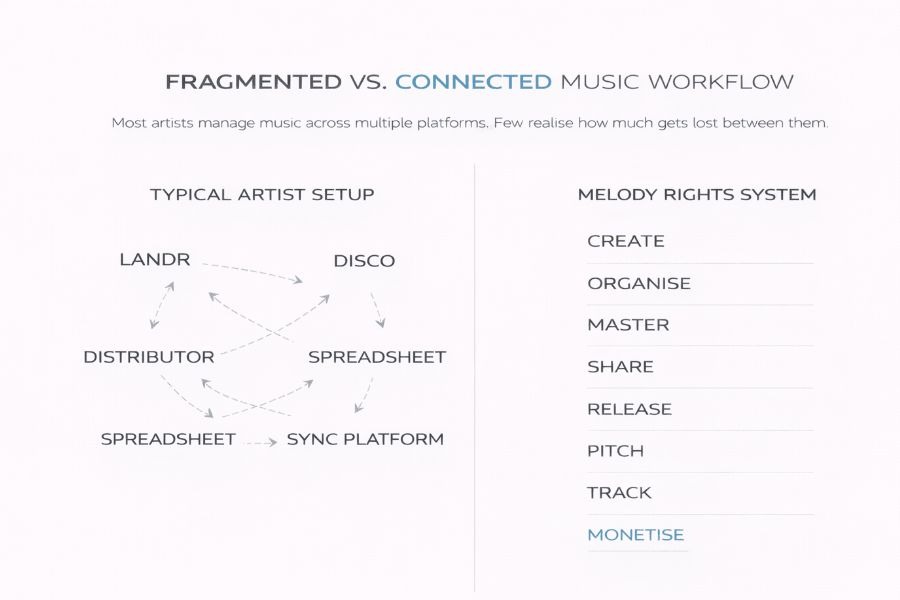
Melody Rights isn’t built as another tool to add to that stack.
It’s built to replace the need for most of it.
Instead of treating mastering, sharing, distribution, rights, and royalties as separate tasks, it connects them into one working system, where each step feeds into the next.
So you’re not restarting every time you move forward. You’re building on what’s already there.
How the System Actually Works
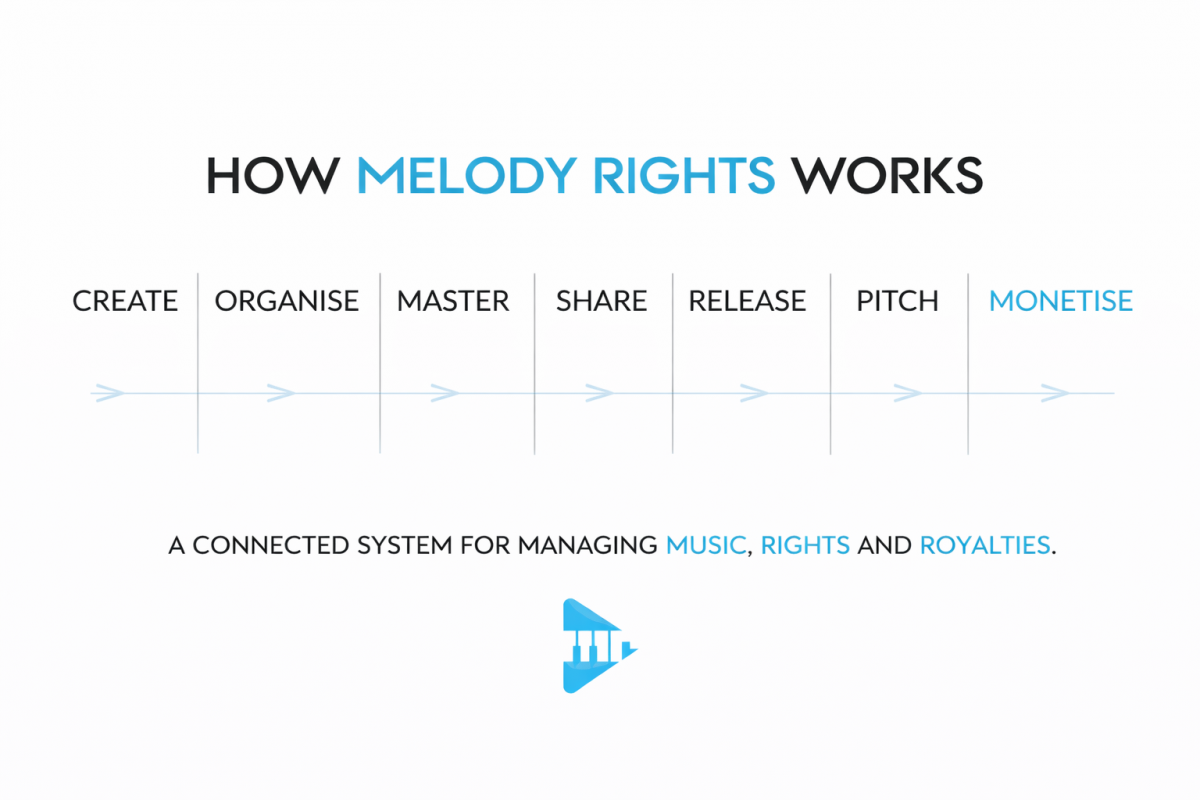
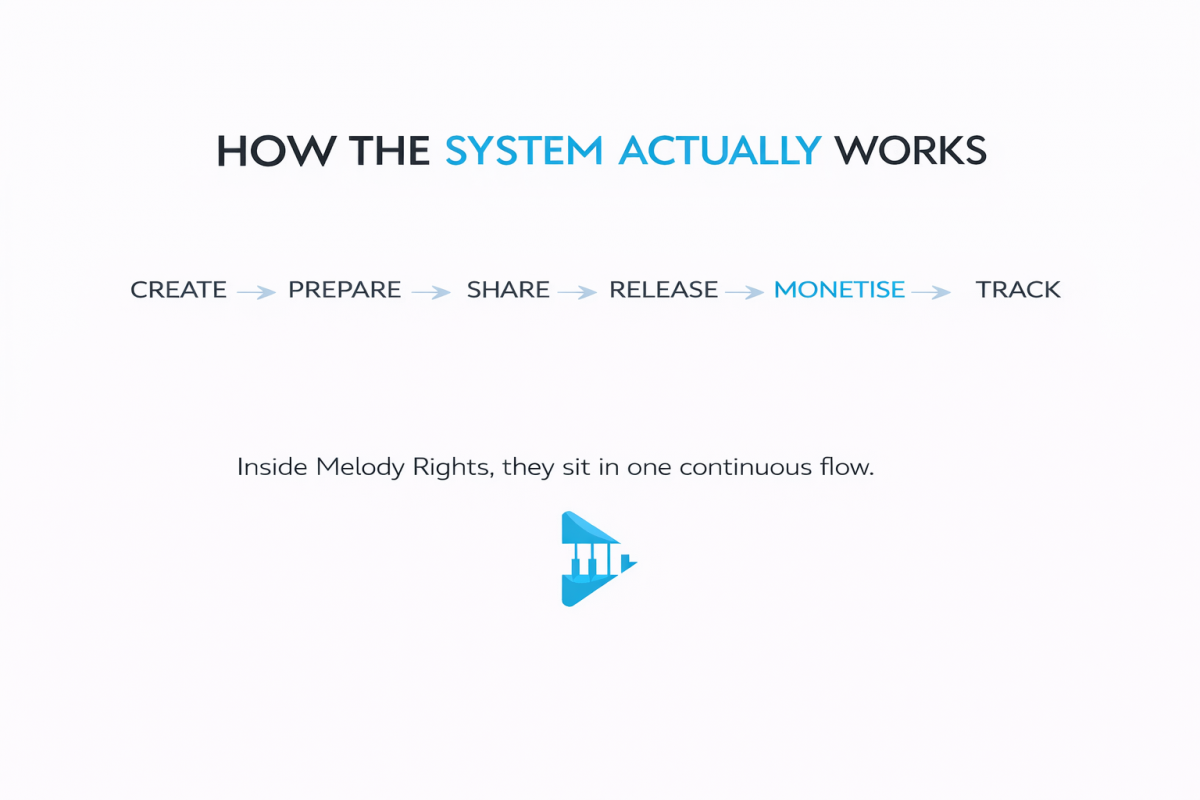
If you strip everything back, the workflow most artists are trying to manage looks like this:
Create → Prepare → Share → Release → Monetise → Track
The problem is those steps usually live in different places.
Inside Melody Rights, they sit in one continuous flow.
You start with the track
Uploading isn’t just storage.
You’re building a structured catalogue, where your music, metadata, artwork, and versions all live together.
This becomes the backbone for everything that follows.
If you’re unsure why this matters, start here:
https://melodyrights.com/what-is-a-music-catalogue
You prepare it properly
Mastering happens inside the same system.
No exporting files. No waiting around. No extra cost layer.
Just a release-ready track, built from what’s already there.
For context, see how this usually works:
https://melodyrights.com/how-much-does-it-cost-to-master-a-song
You send it out
When it’s time to share, you’re not attaching files or sending rough links.
You generate a clean, browser-based playlist that presents your music properly, whether it’s going to a label, supervisor, or collaborator.
No logins on their side. No friction.
Just a straightforward listening experience.
You release it
Distribution doesn’t feel like a separate event anymore.
Because your track is already organised, already prepared, already ready to go.
You’re not rebuilding anything. You’re continuing the same process.
If you’re comparing options, start here:
https://melodyrights.com/independent-music-distribution-companies
You open the door to opportunities
Instead of uploading your catalogue again somewhere else, opportunities sit alongside your music.
You can access sync requests and pitch directly from what you’ve already built.
To understand how this usually works:
https://melodyrights.com/music-sync-opportunities-the-real-pipeline
You see what your music is actually doing
This is where everything either comes together, or falls apart.
Royalties, rights, and performance data are visible in one place.
Not scattered across dashboards.
Not partially tracked.
If you’re trying to piece it together, start here:
https://melodyrights.com/how-to-make-money-from-music-online
You Track, Control, and Grow.
Everything connects back to one place:
- your catalogue
- your rights
- your royalties
- your releases
No duplication and no blind spots.
What This Replaces in Practical Terms
| What artists need | Usually handled by | What that means | With Melody Rights |
| Mastering | External services | Extra cost and steps | Included |
| Sharing music | Private links / tools | Inconsistent presentation | Included |
| Catalogue management | Spreadsheets / CMS | Disconnected data | Included |
| Sync access | Separate platforms | Duplicate uploads | Included |
| Royalty tracking | Multiple dashboards | Gaps and confusion | Included |
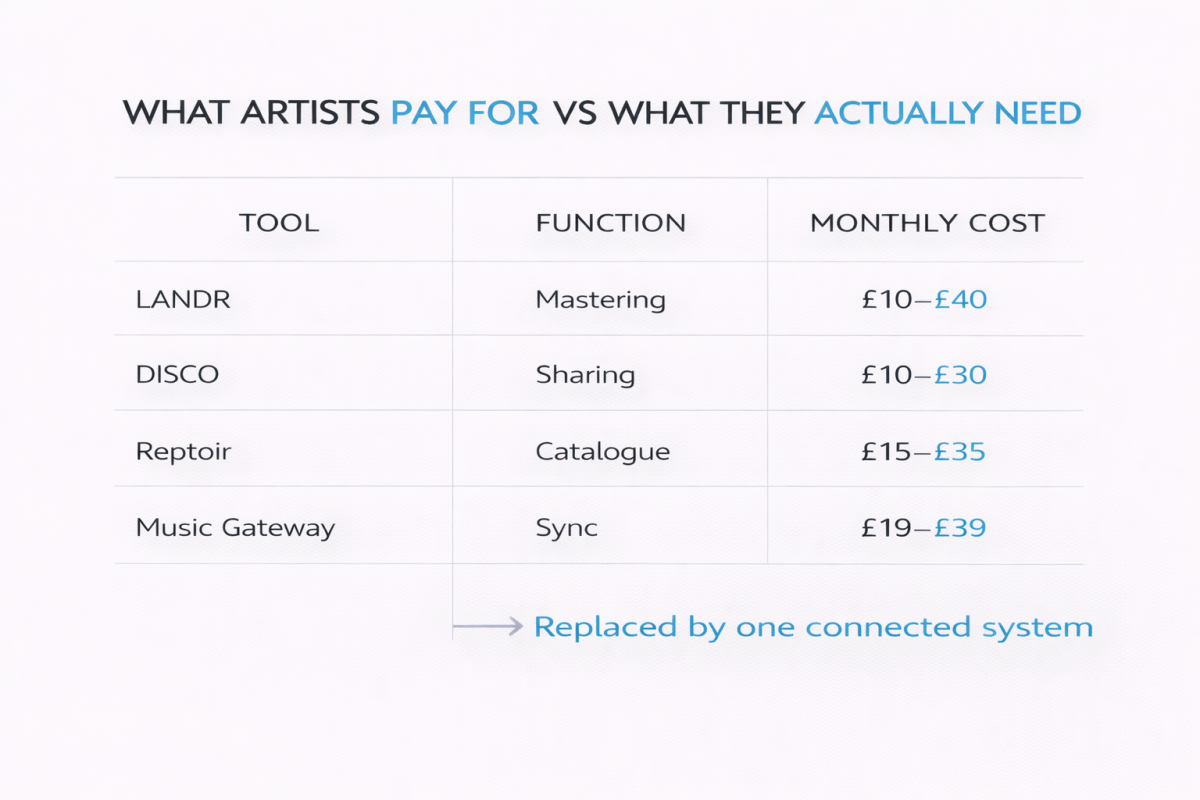
Most artists don’t realise they’re paying for fragmentation until they see it laid out like this.
Where Artists Lose Money (And Why)
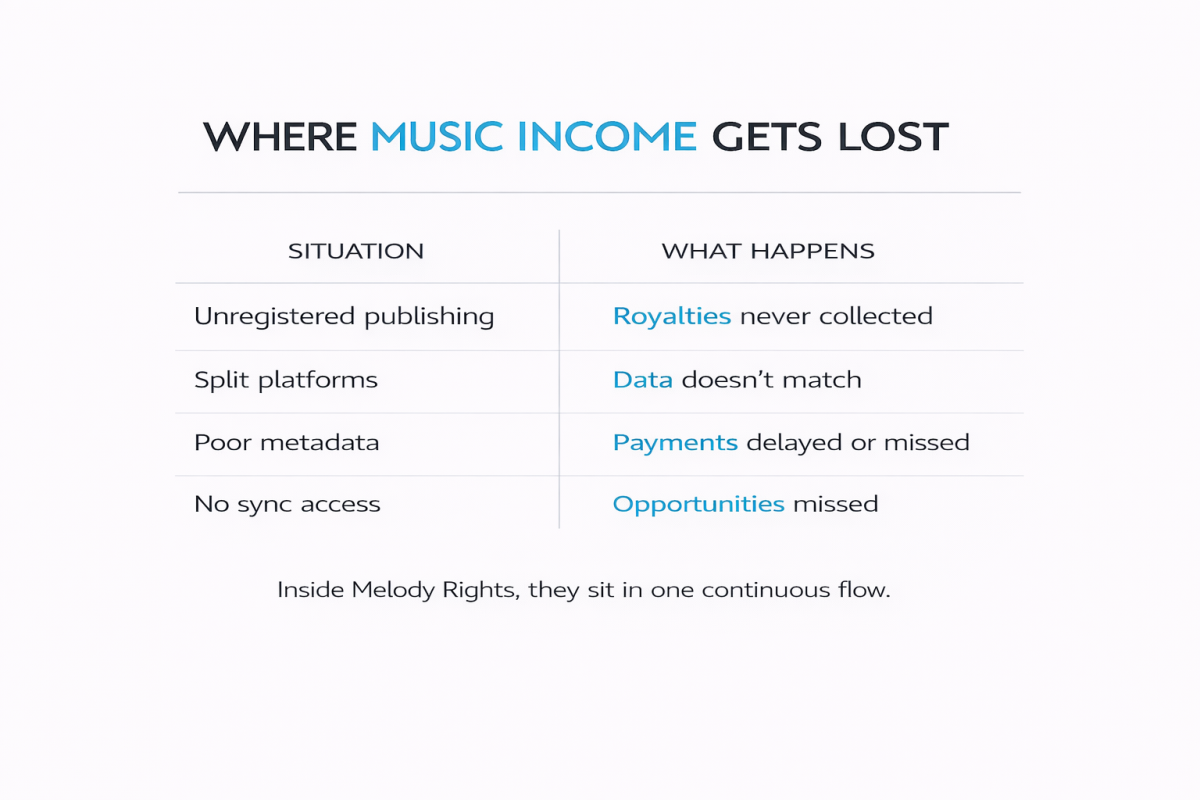
Global royalty collection data from CISAC shows that income is still fragmented across multiple systems and territories, which is why many independent artists never see the full revenue their music generates.
| Situation | What happens | Why it matters |
| Unregistered publishing | Royalties go uncollected | Lost long-term income |
| Split platforms | Data doesn’t match | Missed tracking |
| Poor metadata | Tracks can’t be matched | Payments delayed or lost |
| No sync access | Opportunities missed | No licensing income |
A More Realistic Scenario
An artist releases a track that starts to gain traction.
Streams build. A playlist picks it up. There’s potential.
But behind the scenes:
- The publishing side hasn’t been properly handled.
- The track isn’t fully registered everywhere it should be.
- Sync opportunities pass unnoticed.
- Income appears in fragments, if at all.
From the outside, it looks like progress.
From the inside, it’s incomplete.
System Failure
Over the years, we’ve seen this pattern repeatedly. Artists generating real traction but missing publishing income entirely, simply because their rights weren’t structured properly from the start.
It’s rarely a creative issue, it’s almost always a systems issue.
Where This Fits Into Everything Else You’re Doing
If you’re already trying to understand:
- How to make money from music online.
- How sync licensing actually works.
- What a music catalogue really is.
- Which distribution route makes sense.
You’re already dealing with the same underlying issue.
Too many moving parts, none of them connected.
This is the layer that ties them together.
FAQ
Is Melody Rights just a music distributor?
No. Melody Rights includes distribution, but it also connects mastering, catalogue management, sharing, sync opportunities, and royalty tracking into one system.
Do I still need multiple music platforms?
In most cases, no. Melody Rights is designed to replace multiple tools by bringing your music workflow into one connected platform.
How do I collect all my music royalties in one place?
By managing your catalogue, rights, and releases within a single system that tracks and connects income streams across streaming, publishing, and sync.
Can I master and share music in the same platform?
Yes. Melody Rights allows you to master tracks and generate shareable playlist links without leaving the platform.
Final Thought
Most artists don’t struggle because they lack tools. They struggle because the tools they use were never designed to work together.
Melody Rights isn’t trying to add another layer to that.
It’s trying to remove the need for it.
Closing Line
This isn’t about adding another platform to your workflow.
It’s about removing the need for most of them.
Fact-checked by Bobby Cole, music rights specialist.