
Your song may not be making visible money yet because streams, distributor payouts, publishing royalties, neighbouring rights, and international collections do not report at the same speed. Some streaming income may appear after a few months, while publishing and overseas royalties can take much longer, depending on registrations, metadata, and society processing.
This is one of the most common frustrations independent artists experience after release, especially when streaming activity appears long before royalty systems catch up financially.
Why Streams And Royalties Feel Disconnected After Release
One of the strangest parts of modern music is how quickly everything looks like it’s working.
You release a track on Friday, streams start appearing almost immediately, Spotify for Artists lights up over the weekend, people start sharing the song around, maybe playlists begin picking it up, and from the outside it feels like the machine is finally moving.
Then you check the money. That is usually where the confusion starts.
The payouts feel smaller than expected. Some royalties seem completely absent. The activity around the song looks far bigger than the income attached to it, and because almost nobody explains what happens financially after release, artists often jump to the worst conclusion possible: the song failed.
Most artists do not panic because they are impatient. They panic because the dashboard shows proof that something happened, while the money side gives them silence.
In reality, a lot of music income simply moves far slower than the visibility surrounding it.
Streaming platforms surface audience activity quickly, but royalty systems move much more slowly behind the scenes. Some reporting systems update monthly, some quarterly, and some only reconcile after data passes through multiple organisations first. For many artists, that disconnect creates the feeling that the music is moving but the money is not.
This article is not about release strategies or “how to blow up on Spotify.” It is about understanding why the financial side of music often feels disconnected after release, what delays are considered normal, and what situations are genuinely worth investigating.
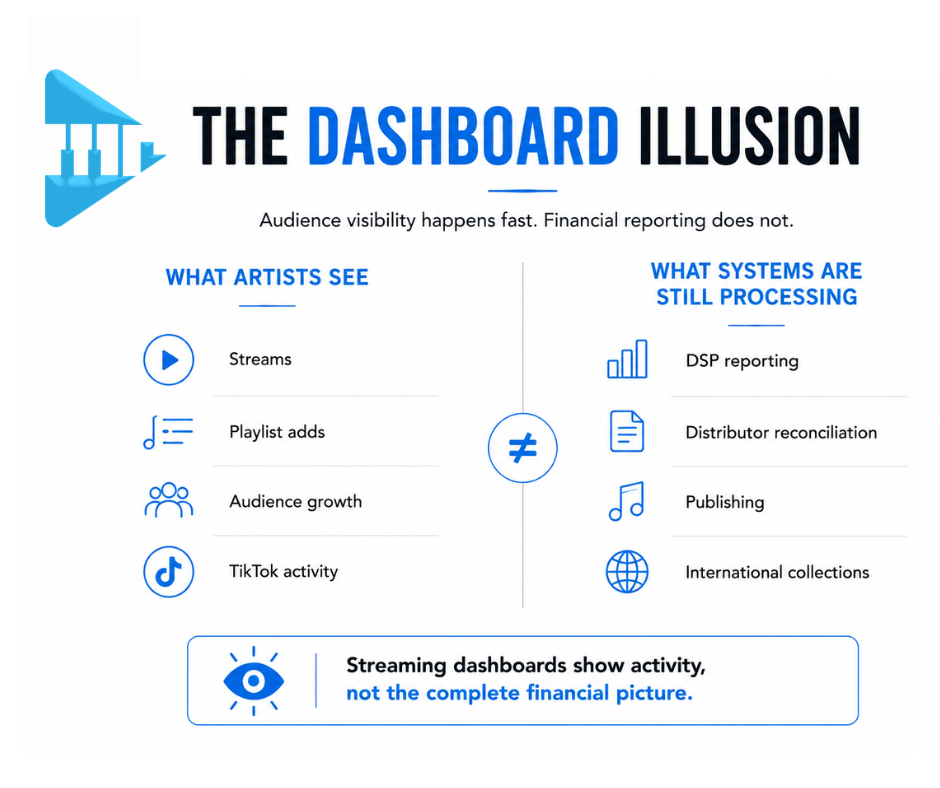
The Dashboard Illusion
A lot of artists still picture music income like this:
Upload song → streams happen → platform pays artist.
That would make sense if music royalties moved through one clean pipeline, but they do not.
One of the biggest misconceptions artists carry into release day is assuming streaming dashboards represent the complete financial picture surrounding a song.
They do not.
Spotify for Artists shows audience activity almost immediately, but the money side of music moves through several slower systems behind the scenes. Distributors, publishing societies, collection organisations, and international partners all process reporting on different schedules, which is why streams and payouts rarely appear in sync.
Spotify activity can appear almost instantly inside Spotify for Artists, but royalty reporting often moves 45–60 days behind the actual streams before distributors begin processing payouts.
TuneCore notes that publishing royalties can take 3–6 months to appear in many cases, while some foreign society collections may take 12–18 months depending on territory reporting schedules. Distributor payouts also depend on DSP reporting cycles, which is why streams and royalties rarely appear in sync financially.
DistroKid’s royalty reporting guidance also explains that platforms report royalties on delayed accounting cycles rather than real-time payouts.
Across the industry, royalty payments operate on reporting cycles rather than real-time accounting.
That is true across distributors, publishing societies, neighbouring rights organisations, and international collection networks alike.
In practice, that means streams generated today may still be moving through distributor reports, publishing systems, and territory reconciliation months later.
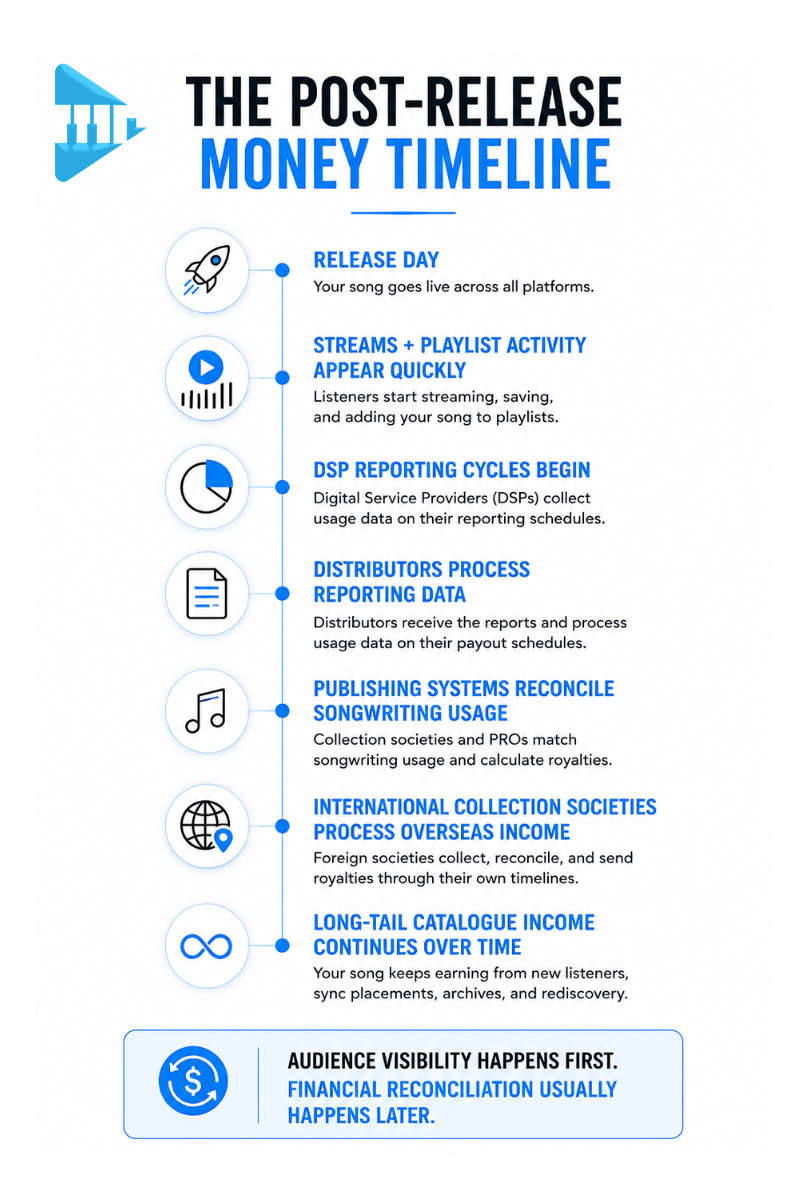
What Actually Happens Financially After Release
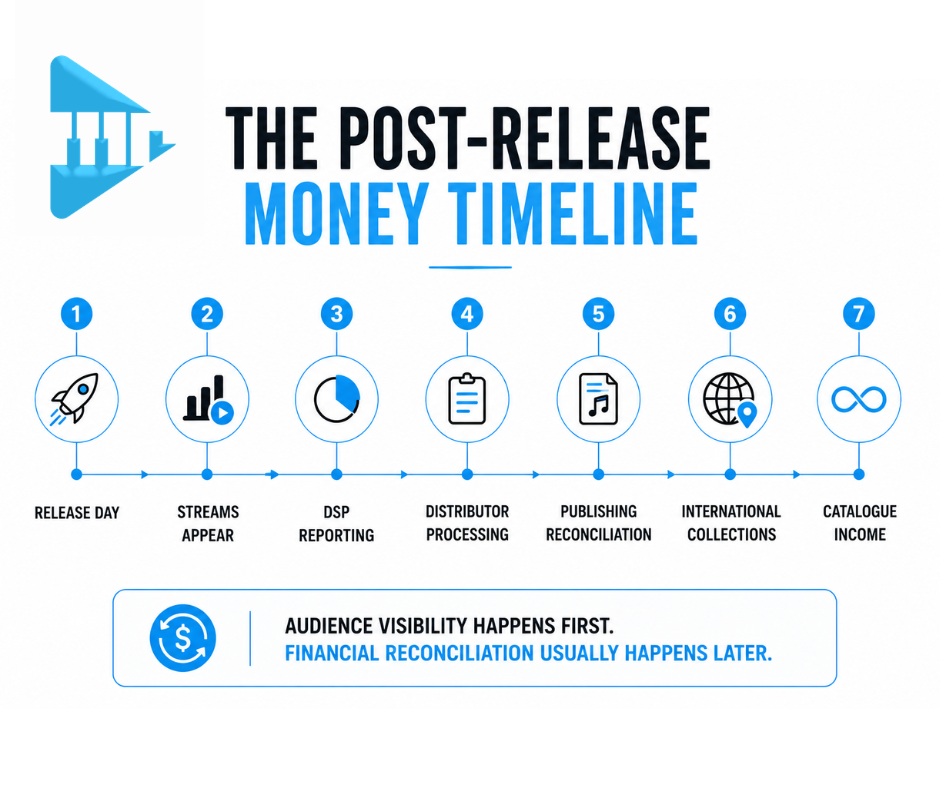
The exact timeline varies depending on distributors, territories, metadata accuracy, and collection systems involved, but these are common patterns many artists experience after release.
| Stage After Release | What Artists Usually See | What Is Happening Financially |
| Week 1 | Streams, saves, playlist activity | Platforms begin tracking usage data |
| Weeks 2–4 | Audience visibility grows | DSP reporting cycles begin |
| Months 2–3 | First clearer payouts appear | Distributor reconciliation begins |
| Months 4–9 | Older releases sometimes begin earning unexpectedly | Publishing and overseas royalty systems continue reconciling |
| Long-term | Income appears uneven over time | Multiple reporting systems continue reconciling independently |
This is one reason artists sometimes feel like older songs “suddenly started working” months later.
In many cases, the royalty systems simply processed the release later than the audience discovered it.
PRS for Music explains that overseas royalties often move through foreign collection societies before reaching the original rights holder, which is one reason international income can appear much later than streaming activity itself.
Even within publishing, royalties are fragmented. PRS and MCPS explain separately that performance royalties and mechanical royalties are processed through different systems, which means reporting timelines do not always move together behind the scenes.
PRS for Music royalty payment schedules show that PRS performance royalties are distributed quarterly, while MCPS mechanical royalties are processed monthly, which further explains why songwriting income rarely arrives in one clean payment timeline.
CISAC’s 2025 Global Collections Report showed creator royalties reaching €13.97 billion globally across its network of societies, highlighting the scale and complexity of modern royalty collection systems.
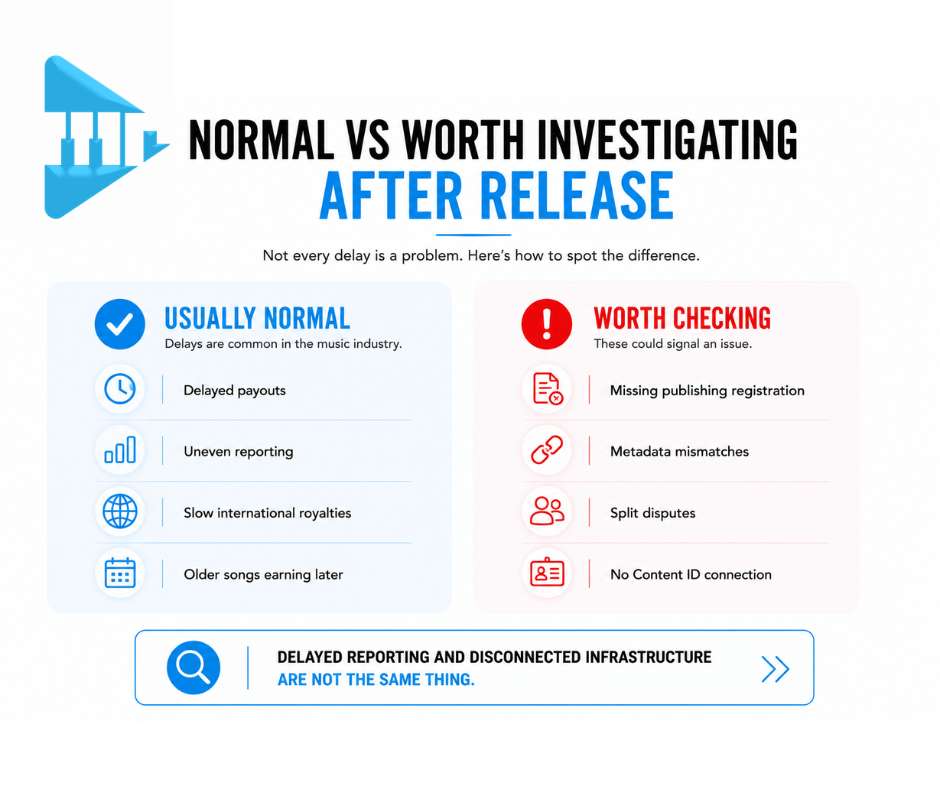
What Is Usually Normal, And What Might Actually Be A Problem
One of the most useful things artists can understand after release is the difference between delayed reporting and disconnected infrastructure.
A lot of situations that feel alarming early on are actually fairly common across the industry.
| Situation | Usually Normal? | Worth Checking? |
| Streams are visible, but little income yet | Yes | Usually not |
| Publishing royalties delayed for months | Common | Sometimes |
| International royalties arriving unevenly | Very common | Usually not |
| Older songs are suddenly earning later | Common | No |
| TikTok or YouTube activity without clear payouts | Sometimes | Worth checking |
| One collaborator receives royalties while another does not | No | Yes |
| Metadata inconsistencies across systems | No | Yes |
None of these situations automatically means royalties are permanently missing.
The important distinction is whether the money is delayed or whether the systems collecting it were never connected properly in the first place. Those are very different problems.
A lot of artists discover after release that their distributor was only collecting part of the picture. Our guide on how to register your music properly explains how publishing, metadata, and royalty systems actually connect behind the scenes.
If royalty statements still feel disconnected from the activity surrounding your music, this breakdown of what royalties in music actually are explains why payments rarely arrive in one clean timeline.
False Failure Signals After Release
One of the hardest parts of releasing music independently is how easy it is to interpret delayed reporting emotionally.
A song can appear financially quiet during its first few months while publishing systems, distributor reporting, international societies, and reconciliation infrastructure are still processing the release behind the scenes.
That does not mean every song eventually becomes profitable. It means early financial silence is not always reliable evidence that something is broken.
Some releases build slowly. Some royalties report slowly. Some catalogue income compounds long after the original release cycle has passed.
Artists often judge songs emotionally long before the accounting systems underneath them have fully caught up.
That psychological gap matters more than many people realise.
Modern music platforms are built for instant visibility, not instant accounting. If artists are never taught how royalty timelines actually work, normal delays can easily start feeling like proof that the release failed.
Why Some Songs Quietly Earn More Over Time
Two songs can generate similar streaming numbers while producing very different long-term income outcomes.
One release may be fully connected behind the scenes, with organised ownership records, publishing registrations, documented splits, and international collection pathways already in place.
Another may only be partially connected.
To listeners, both songs look equally active.
Financially, they may behave very differently over time.
That is one reason catalogue management matters far more than many artists realise early in their careers. Music income is not only shaped by audience size. It is also shaped by how clearly the systems surrounding the music are connected.
This becomes especially important once sync licensing, neighbouring rights, production music libraries, and long-tail catalogue income enter the picture.
Sync is one of the clearest examples of how older songs can continue generating value long after release. Our guide to music licensing for film and TV breaks down how catalogue income expands beyond streaming platforms alone.
This is the point where music starts behaving less like a single release and more like a long-term catalogue. Our breakdown of what a music catalogue actually is explains why older songs often continue generating value long after their original release cycle.
If you are exploring sync income more seriously, these guides on music sync opportunities and how they actually work and production music libraries explained simply connect naturally with the long-tail income patterns discussed here.
Before You Panic, Check the Pipes
If your streams are visible but the money feels missing, the next step is not refreshing your dashboard again. It is checking whether your song is registered, matched, split correctly, and connected to the right royalty systems.
Melody Rights helps independent artists see where their catalogue, metadata, splits, and royalty setup may be leaking income before those gaps become long-term problems.
Start by checking your rights setup, then decide what needs fixing.
Final Thought
Most artists do not need more release-day hype. They need clearer expectations about what happens afterwards.
The financial side of music has always moved more slowly than the visibility side. Royalties travel through multiple systems, across multiple timelines, often long after the excitement surrounding a release has already peaked publicly.
Once artists understand that properly, they stop treating every delayed payout as evidence that the music failed.
Instead, they can start asking better questions.
Is the publishing registered correctly?
Are collaborator splits documented properly?
Does the metadata match across systems?
Is the music connected to all the systems responsible for collecting income?
Those questions are far more useful than refreshing dashboards every few hours and trying to judge a release financially before the infrastructure underneath it has fully processed.
Because uploading music is not the end of the process.
For most independent artists, it is the beginning of the part nobody really explains clearly enough.
FAQs
How long do Spotify royalties take to appear?
Most Spotify royalties appear through distributors roughly 2–3 months after streams occur, although publishing and international royalties can take much longer depending on registrations and collection societies.
Why do I have streams but no money yet?
Streaming activity often appears before royalty systems finish processing distributor reports, publishing data, and international collections. This delay is common after release.
Can older songs suddenly start earning money?
Yes. Publishing royalties, sync usage, international collections, and catalogue discovery can all create delayed income months or years after release.
Written by Bobby ColeBobby Cole is a composer, producer, and music rights strategist with over 25 years of experience in sync licensing, publishing, royalty systems, and independent artist development. As the founder of Melody Rights, he helps artists understand the parts of the music industry most distributors never explain, from publishing registrations and metadata to long-term catalogue income and royalty collection.