
Most “royalty-free” advice is written for buyers, not the people who made the music.
Creators want something that won’t get them claimed, brands want something they can use without legal emails, and marketplaces want the sale to feel simple. So the term gets watered down until it sounds like a promise it was never meant to make.
If you’re a DIY artist, you need the real version. You’ll run into “royalty-free” the moment your tracks start getting licensed. The one that explains what it covers, what it never covers, and the boring details that decide whether you get paid, get claimed, or get ignored.
Because royalty-free isn’t a genre. It’s paperwork.
What does royalty-free mean?
Royalty-free music means someone pays once (or via a subscription) for a licence to use a track without paying ongoing fees each time it’s used. You still own the music. They’re buying permission, not copyright, and what they’re allowed to do depends on the licence.
People search “define royalty free” because they want a straight answer, not a sales page.
If you’ve ever searched royalty-free music meaning and left more confused than you started, it’s usually because nobody explains the scope part properly.
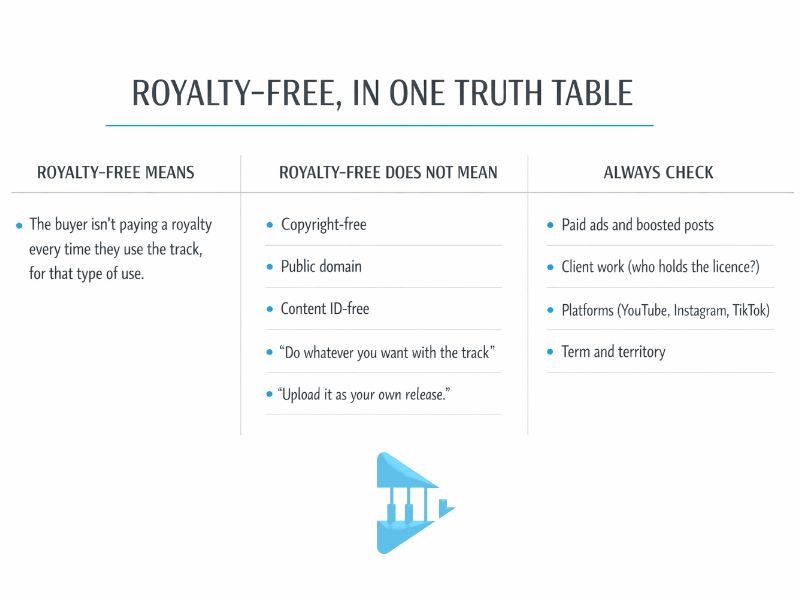
Royalty-free, in one truth table
Royalty-free means
- The buyer isn’t paying a royalty every time they use the track, for that type of use.
Royalty-free does not mean
- Copyright-free
- Public domain
- Content ID-free
- “Do whatever you want with the track”
- “Upload it as your own release”
Always check
- Paid ads and boosted posts
- Client work (who holds the licence?)
- Platforms (YouTube, Instagram, TikTok, podcasts, websites)
- Term and territory (how long it lasts, and where in the world it applies)
- Content ID policy and what support looks like if a claim happens
Why the term exists
This is where the confusion started.
“Royalty-free” wasn’t invented as an artist flex. It was a buyer workaround.
In TV and broadcast, music gets licensed, then the programme airs, and airs again. That repeat use can trigger royalties over time, and broadcasters handle those payments through established royalty systems behind the scenes.
Internet creators didn’t fit that world. Different budgets, different scale, different expectations. So royalty-free became shorthand for a simpler deal: pay once for permission, use the track within the licence scope, and you’re not paying again every time the video gets used or re-used.
Founder insight (Bobby Cole, Managing Director, Melody Rights):
“Royalty-free came in because the TV licensing framework didn’t fit internet creators. It became a one-off licence, buy once and use under the terms, instead of paying again every time something airs.”
What a royalty-free licence is used for today
That shorthand is now everywhere, especially on marketplaces built for online content.
Most royalty-free licences are designed primarily for internet use, with broadcast usually needing different terms. They’re built for creators, small businesses, agencies, and anyone who needs music fast, with a predictable price.
So in real life, royalty-free usually shows up in:
- YouTube videos (music paired with visuals)
- Social content
- Podcasts (depending on the licence terms)
- Websites, presentations, internal brand content
Where people get burned is assuming “royalty-free” means the same licence covers every platform, every budget, every campaign, forever.
It doesn’t.
A quick scope reality check
| Use case | Often covered by a basic royalty-free licence? | The trap to check |
| Organic YouTube video | Usually | Content ID claims can still happen |
| Paid ads / boosted posts | Sometimes excluded | You may need an upgraded licence |
| Client work | Depends | The client might need to be the licensee |
| TV / broadcast / cinema | Often not | Usually a different licence is required |
How royalty-free should be used properly
Royalty-free works when the licence matches the use. That’s the whole game.
Before anyone uses your track, or before you agree to place music under royalty-free terms, get clear on five things.
- Who is the licence for?
Is it issued to you personally, your channel, your business, or the client who’s publishing it? - Where will it be used?
Which platforms, and does the music have to sit under video, not as a standalone upload? - Is monetisation included?
Organic use is one thing. Paid ads and boosted posts are another. - What’s the term and territory?
How long does it last, and where in the world does it apply? - What proof and support exists if something goes wrong?
Licence certificate, receipt, a copy of the terms, and a real dispute path if a claim hits.
Save these three things
Do this once and you’ll thank yourself later.
- Licence certificate or receipt
- Copy of the licence terms (PDF or screenshot)
- Track reference (invoice number, track ID, exact filename)
Client work: who should hold the licence?
This is where “royalty-free” turns into an argument.
If you’re making content for a client, the most important question isn’t “is the track royalty-free?”
It’s who the licence is issued to.
Some licenses are personal. They cover your channel, your business, your uploads.
That’s fine until you hand the edit over, the client republishes from their own accounts, or they turn it into a paid campaign.
A simple rule that avoids most disasters: the licence needs to cover whoever is publishing and monetising the content, which is often the client.
So check the licence terms for language like:
- Client work licence
- Transfer, sublicense, or “agency use”
- Seats, teams, or multi-user accounts
If it’s unclear, treat it as unclear. Get it confirmed in writing. Save the proof.
Royalty-free does not mean Content ID-free
This is the bit that catches people out.
Royalty-free means the buyer isn’t paying again for repeated uses under that licence. It doesn’t mean YouTube’s Content ID system will automatically leave the track alone.
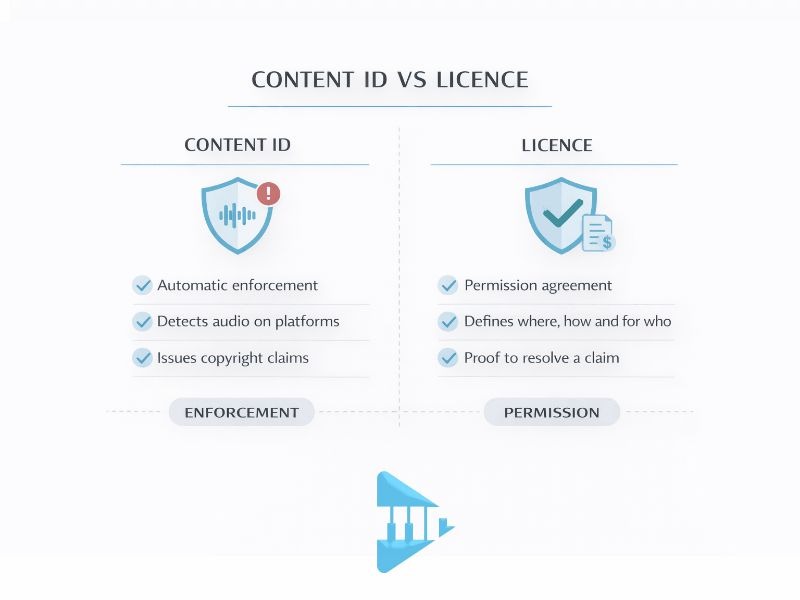
Content ID is enforcement, a licence is permission. They can overlap, and they can clash.
People search “youtube music license” and “licensed music for youtube videos” for a reason. They’re not trying to become lawyers. They’re trying to avoid a Content ID claim landing on a finished upload.
Licensed but claimed: what to do
- Open the claim details and check who claimed it and what track it matched.
- Pull your licence certificate or receipt.
- Confirm your use fits the scope, especially paid ads and client publishing.
- Dispute the claim with proof, using the correct option in YouTube Studio.
- If you bought it from a provider, escalate through their support so they can clear it on their side.
YouTube explains the dispute process inside YouTube Studio help if you need the official steps.
What not to do
- Don’t delete and reupload in panic. You can lose momentum and still get claimed again.
- Don’t assume a claim means the music was stolen.
- Don’t treat “royalty-free” as automatic immunity.
The 10-minute royalty-free licence checklist
Before you buy a track, before you deliver a client video, before you place your own music anywhere, run this.
- Who is covered, me, my channel, my client, my company?
- Where will it be used?
- Is monetisation covered?
- Is paid advertising covered?
- Is client transfer or sublicensing allowed?
- Is there a term or territory limit?
- Can I edit, loop, or cut the track under voiceover?
- Any limits on number of projects, channels, seats?
- What is the Content ID policy, and does it mention whitelisting or clearing?
- What proof do I receive, and what is the dispute support process?
- Are there restrictions on uploading audio-only?

For artists: you still need rights admin, even if your music is “royalty-free”
Royalty-free is not a buyout. You’re not giving your rights away, you’re granting permission.
If your track is going to be used repeatedly by lots of different people, your backend needs to stay calm and consistent. That means splits agreed early, metadata that doesn’t change every time you export, and versions named properly (full mix, 60/30/15 cutdowns, and an instrumental).
If you’re doing it DIY, the route depends on where you’re based.
In the UK, you’ll typically be looking at PRS for Music for registering works.
In the US, ASCAP is one of the main options for writers.
If you’ve never set your registration up cleanly, start here: How to register my music.
One warning that saves a lot of pain: if you’re working with an administrator, don’t duplicate registrations blindly. That’s how conflicts happen, and they can take months to untangle.
Where Melody Rights fits
Melody Rights isn’t a royalty-free marketplace where buyers purchase tracks directly, at least not today.
What it does do is help artists keep the backend clean, and send music to places that license tracks under royalty-free terms.
If you want to go deeper on the admin side, these Melody Rights guides are the most relevant:
FAQs
What does royalty-free mean in music?
It means a buyer pays once (or via subscription) for permission to use a track without paying ongoing fees each time it’s used. They don’t own the music. The allowed uses depend on the licence scope.
Is royalty-free the same as copyright-free?
No. Royalty-free music is still copyrighted. You’re paying for permission to use it under specific terms.
Why did I get a YouTube claim if I paid for a royalty-free licence?
Because Content ID is an automated enforcement. A valid licence and a claim can coexist. Use your proof, dispute correctly, and escalate through the provider if needed.
Final word
Royalty-free is simple when the paperwork is clean.
The artists who win with this stuff aren’t always the ones with the fanciest tracks. They’re the ones who can respond fast and calmly when anything gets questioned, because they’ve got the licence, the scope, the proof, and the admin handled.
That’s how you keep your music moving. That’s how it keeps earning.
____________________________________________________________________________
Fact-checked by Bobby Cole, music rights specialist.