
AI Mastering Explained: What Music Mastering AI Replaces
Most independent artists don’t get excited about mastering.
By the time a track reaches this stage, the creative work is already done. The decisions have been made and the song feels finished.
What’s left is the step that decides whether the track is actually ready to be released, uploaded, and played outside your own setup.
That’s where AI mastering enters the picture.
Not because artists were chasing automation, but because they needed a more reliable way to get through the final step.
Quick Answer:
Music mastering AI is used to prepare finished tracks for release by ensuring consistent loudness, balance, and playback across platforms. For independent artists, it replaces delays and uncertainty at the final release stage, without making creative decisions or altering artistic intent.
What Mastering Is Actually Used For
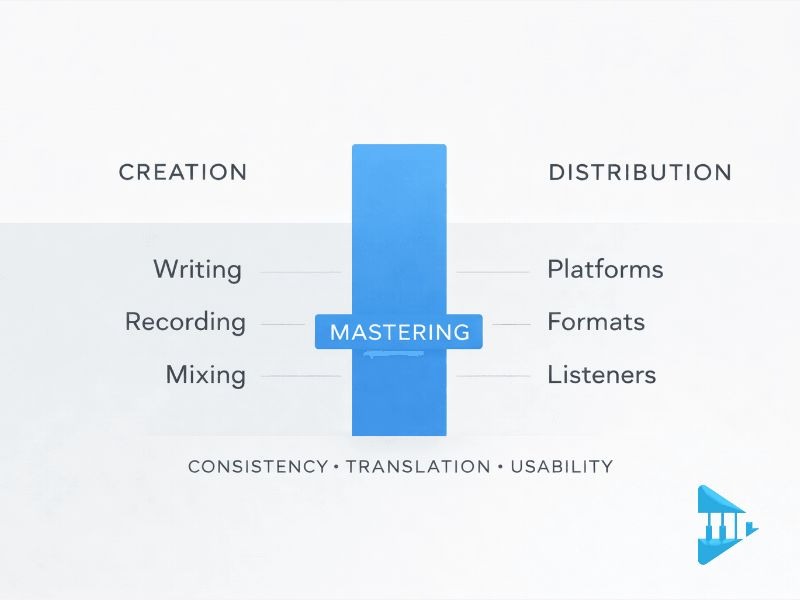
Mastering exists to make music usable in the real world.
It’s the stage that prepares a finished mix to behave predictably across different systems, platforms, and listening environments. Not to change the song, but to ensure it holds together once it leaves the artist’s control.
At a system level, mastering is about translation and consistency.
It’s the point where music stops being personal and starts being public.
That’s why mastering has often sat outside the creative flow for many artists. Its role isn’t expression, it’s making sure the music is ready to leave the studio.
Why Independent Artists Handed Mastering Off in the First Place
Before AI was used in Mastering, DIY artists were already handing mastering off. Not because they didn’t care about sound, but because they needed certainty at the point of release. With limited time, inconsistent listening environments and wildy varied home studios.
Once a track was finished creatively, most artists didn’t want to second-guess whether it would hold up everywhere else. Mastering was a step that could be handled cleanly, so the release could move forward without stalling.
Whatever most opinions about AI, this pattern matters. It shows that mastering was already treated as a release requirement, rather than a creative space.
Services like LANDR didn’t grow by promising better taste or artistic insight. They grew by offering an easy way through the final gate.
What “Release-Ready” Really Means (And What It Doesn’t)
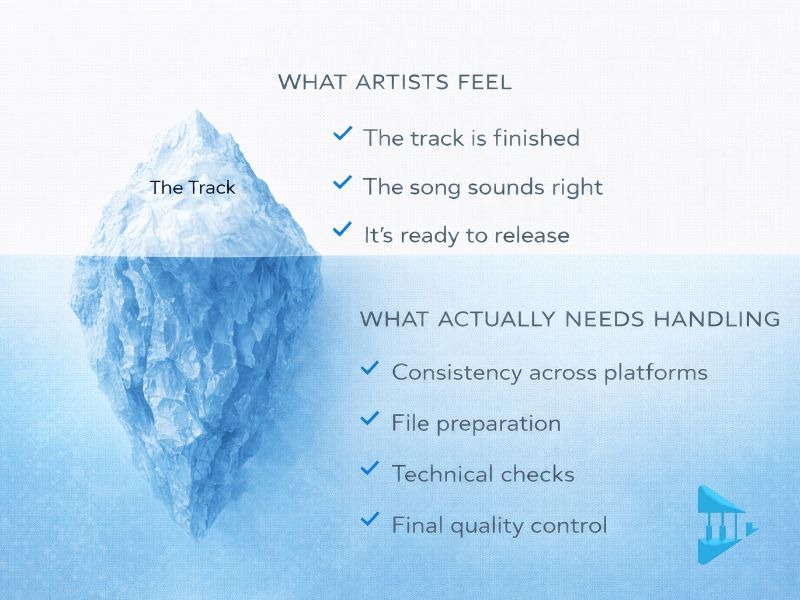
Release-ready does not mean flawless.
It means the track is usable, consistent, and unlikely to cause problems once it’s distributed. It means it won’t fall apart next to other music, or behave unpredictably on different platforms.
For independent artists, release-ready is about reliability.
It’s about reducing risk at the moment the music leaves their hands.
If you want a clearer sense of what mastering has traditionally been there to solve, we break that context down in How Much Does It Cost to Master a Song?
Mastering exists to remove uncertainty, not to validate creativity.
Where Human Mastering Still Makes Sense
AI mastering works best when speed and consistency matter most. That doesn’t mean it’s the right fit for every situation.
There are still times when working with a human mastering engineer makes more sense, especially when the release needs something more specific than reliability alone.
For example:
- music that’s highly dynamic or deliberately unconventional, where standard references don’t really apply
- projects that need a very specific sonic identity shaped through back-and-forth collaboration
- releases where the relationship with a particular mastering engineer is part of the artistic process itself
In those cases, the value isn’t just the end result. It’s the perspective, feedback, and context a human brings to the final stage.
Where Music Mastering AI Fits in the Release Process
Music mastering AI didn’t appear by accident.
Automation usually shows up first in parts of music-making where consistency matters more than interpretation. Mastering fits that bill. Its job is to make sure finished tracks still work once they leave the studio.
Once music leaves the studio, its ability to travel, be distributed, and earn depends less on creativity and more on whether it’s usable inside real systems, which we explore further in How to Make Money from Music Online.
That doesn’t mean everyone approaches mastering the same way. In professional audio forums, engineers often point out that artists who choose automated mastering are usually prioritising speed and momentum over a long, collaborative mastering relationship. One engineer says, creators who opt for AI mastering were often never looking for a traditional mastering partnership in the first place.
That difference isn’t ideological. It’s practical.
AI mastering tends to show up right when deadlines tighten, releases are waiting, and momentum matters most.
What Music Mastering AI Replaces (And What It Doesn’t)
This is usually where things get muddled.
When artists hear “music mastering AI,” it can sound like creative decisions are being handed over to a system. In reality, what’s being replaced has far more to do with release friction than with taste.
For independent artists, mastering sits at the point where a track feels finished creatively but isn’t yet ready to be released.
That’s usually where delays creep in. Waiting for availability, scheduling back and forth, second-guessing whether a track is really ready to leave the studio.
Music mastering AI is used to remove those bottlenecks. Its role is to help finished tracks move forward without getting stuck at the final handover. It doesn’t reinterpret the music or decide how a song should feel. Those choices were already made earlier.
This isn’t controversial among mastering engineers. In professional forums like Gearspace, mastering is consistently described as quality control and translation.
By the time a track reaches this stage, the creative intent is already set. AI mastering works after those decisions are made, not instead of them. When you separate what slows a release down from what actually shapes the music, the difference becomes clearer.
What AI mastering removes from the release process | What remains creative and human
| What AI mastering removes from the release process | What remains creative and human |
| Waiting for availability | Creative taste |
| Scheduling and revision delays | Artistic intent |
| Release hold-ups | Mix decisions |
| Inconsistent playback across platforms | Emotional context |
Once the creative work is complete, mastering’s job is to keep releases moving. Music mastering AI simply removes friction at that final stage so finished tracks don’t sit unreleased longer than they need to.
Why Getting Music Out Matters More Than Getting It Perfect
Independent artists don’t operate on long album cycles.
They release frequently, and they build momentum over time. Music that stays unfinished doesn’t travel, no matter how strong it is creatively.
This pressure is often intensified by fragmented workflows and disconnected tools, something we examine in more detail in Platforms for Musicians.
In that reality, consistency often matters more than perfection.
Not because quality doesn’t matter, but because stalled releases help no one.
AI mastering helps to keep the system moving.
Where AI Mastering Fits in the Release Process
At Melody Rights, AI mastering sits inside a wider release workflow.
Once the creative decisions are complete, it helps clear the way for the final stage so music can move on. It isn’t there to replace human judgment or taste; the focus is on usability and consistency.
Seen this way, AI mastering supports the release without getting involved in creative decisions.
When You Understand the Job, the Tool Makes More Sense
AI mastering exists because mastering has always been a practical step, and independent artists needed a more reliable way to get their music released.
When you understand what mastering is actually for, the tool makes more sense. It stops feeling abstract and starts looking like a practical way to get a track released.
FAQs About Music Mastering AI
What is music mastering AI actually used for?
In practical terms, it’s used to get a finished track ready to release without slowing everything down. It helps make sure the music behaves consistently across platforms so artists can move on once the creative work is done, rather than getting stuck at the final step.
Does AI mastering replace human mastering engineers?
No. It replaces waiting, scheduling, and release delays, not judgement or taste. Human mastering still matters when an artist wants feedback, collaboration, or someone shaping decisions with context in mind.
Why did AI appear in mastering before other music tasks?
Because mastering focuses on repeatable outcomes and consistency, which made it a natural place for automation to appear first.
Choosing AI Mastering Based on Workflow, Not Ideology
For independent artists, the decision usually isn’t whether AI mastering is good or bad. It’s whether it removes friction at the moment a track is ready to be released.
When you understand what mastering is actually for, where it sits in the release process, and what it does and doesn’t replace, the choice becomes easier to make. Less abstract. Less intimidating. More practical.
Fact-checked by Bobby Cole, music rights specialist.