
Royalty Statement Meaning for Music Artists
If royalty statements were designed for artists, they’d be easier to read.
Instead, most of them feel like accounting documents with labels you didn’t choose, categories you don’t recognise, and adjustments nobody bothered to explain.
This guide breaks down royalty statements in plain English, so you can understand what you’re looking at and do a quick sense-check without turning into an accountant.
Transparency note: royalty statement formats vary between distributors, PROs, neighbouring rights organisations, and publishers. This guide doesn’t use fake screenshots or invented examples. It focuses on the common fields that show up across most music royalty statements.
What is a royalty statement in music?
A royalty statement is a report showing how your music generated income during a specific period. It shows where the money came from, what deductions or adjustments were applied, and the final amount paid to the rights holder.

Royalty statement meaning in music
The simplest way to think about a royalty statement is this: it’s a receipt.
It tells you four things:
- What period the money relates to
- What usage happened, and where
- What got deducted or adjusted
- What you were actually paid
“A royalty statement doesn’t tell you how successful your music is. It tells you how accurately your rights are being tracked.”
– Bobby Cole, Founder of Melody Rights
Where royalty statements usually come from
One reason artists get confused is that they expect one statement to cover everything.
It doesn’t.
Music income runs through different systems, so the same song can generate multiple statements through multiple rights pipelines.
1) Distributor statements
These usually cover recording income from streaming platforms and downloads.
2) PRO statements
These cover performance royalties on the songwriting side, from radio, TV, live venues, and public performances.
If that distinction still feels blurry, read Mechanical vs Performance Royalties.
3) Neighbouring rights statements
These cover recording performance income, often from radio, TV, and public play. This is a separate pipeline again, which is why it’s often missed.
For the bigger picture, see 4 Types of Music Royalties Explained.
If you haven’t registered your music properly across these systems, some of that money may never reach you in the first place. That’s why How to Register My Music matters.

Royalty Statement Columns Explained
Most royalty statements look different on the surface, but they usually contain the same core information once you know what to look for.
Once you understand these fields, most statements become much easier to read, even when the column names change.
Royalty Statement Columns, Explained
| Column label (may vary) | What it means | Why it matters |
| Statement date | When the report was issued | Helps you track reporting cycles |
| Earnings period | When the music usage actually happened | Statements often report usage months later |
| Track title | The song or recording that generated income | Lets you confirm which releases earned money |
| ISRC | Unique code identifying the recording | Ensures royalties are matched to the correct track |
| Territory | Country where the music was used | Shows where your audience activity occurred |
| Source/service | Platform or broadcaster reporting the usage | Helps identify income sources |
| Usage type | Stream, download, broadcast, etc. | Different uses generate different royalty rates |
| Units/quantity | Number of uses or plays | Shows the scale of activity |
| Deductions / withholding | Fees, taxes, or adjustments applied | Explains why final payments are lower |
| Net payable | Final amount paid to the rights holder | The actual payment received |
How to read a royalty statement in 3 steps
You don’t need to analyse every number straight away. Start with three quick checks.
1. Check the earnings period
Look at the earnings period first. This tells you when the music usage actually happened, which is often earlier than artists expect.
2. Confirm your tracks appear
Scan the track titles and make sure the songs you expect to see are there and labelled correctly.
3. Look at the net payable
Check the net payable. This is the final amount being paid after deductions, taxes, or adjustments.
Quick rule: if the period, tracks, and net payable all make sense, the rest of the statement usually follows.
Why royalties arrive late
Royalty payments are slow because the system has layers.
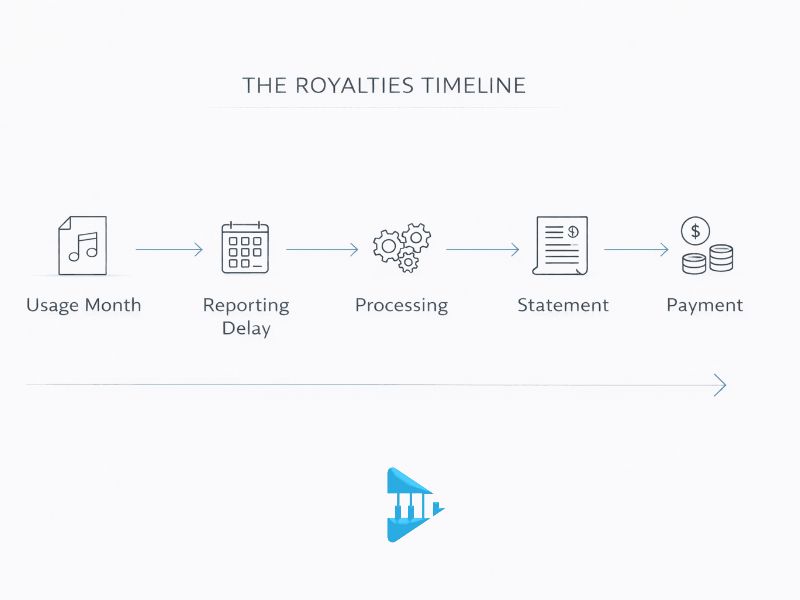
Music gets used first. Then that usage has to be reported, processed, matched to the right rights holders, and turned into a statement before any payment is made.
The usual causes of delay are:
- Reporting cycles from platforms and broadcasters
- Processing and matching against metadata and registrations
- International collection across multiple societies
- Conflicts and claims that hold money back
That’s why “my streams are up” doesn’t always mean “my statement is up” in the same month.
Common royalty statement mistakes and red flags
A few problems come up again and again:
- Assuming one statement covers all royalties
- Comparing statement money to near real-time platform stats
- Ignoring metadata because it feels boring
- Not tracking alternate versions properly
- Collabs with no clear splits
- Key tracks or territories missing without explanation
- Deductions or negative adjustments you can’t identify
If you spot one of these, don’t panic. It may be a delay, a metadata problem, or a rights issue that needs checking.
What to do if something looks wrong
Start simple.
1. Check the basics
Confirm the track titles, versions, and identifiers match what you released.
2. Compare the pattern
Look at your dashboards for the same period. You’re checking for consistency, not expecting a perfect match.
3. Look for the likely cause
Missing metadata, ownership conflicts, reporting delays, or withholding can all affect what appears.
4. Contact the right organisation
Distributor issue, contact the distributor. PRO issue, contact the PRO. Neighbouring rights issue, contact that organisation.
A few terms worth knowing
- Earnings period: when the usage happened
- Payable date: when the payment was issued
- Adjustment: a correction from a previous period
- Withholding: tax held back before payment
- Net payable: what you actually receive
Questions to ask support
If something looks wrong, ask specific questions:
- What is the earnings period for these lines?
- Can you confirm the ISRC or track identifier?
- Are there reporting delays for this source?
- Are any lines unmatched, held, or in conflict?
- If there was an adjustment, what period did it relate to?
The habit that prevents quiet money leaks
- Save each statement using the same file format
- Keep a simple release list with ISRCs and collaborators
- Do a quick check every time a statement lands
- Log anything that looks off
FAQs
Why is my royalty statement so low when my streams are up?
Often, you’re looking at different time windows. Streams dashboards can reflect recent activity, while statements reflect delayed reporting and processed periods. Deductions, withholding, and adjustments can also reduce the net payable.
Do distributors pay all music royalties?
Usually no. Distributors primarily handle income tied to recordings on DSPs. Songwriter performance royalties and neighbouring rights are often collected through separate systems.
How often should artists check their royalty statements?
Check every time you receive one. A quick scan catches missing tracks, period mismatches, and repeated deductions before they become long-term problems.
Next step
Understanding your royalty statement is the first step. Keeping your rights, registrations, and reporting organised over time is the harder part.
If you want to build the foundation properly, start with How to Register My Music.
If you’d rather not manage that whole process manually as your catalogue grows, Melody Rights is built to help artists keep the admin side clear, organised, and much easier to stay on top of.
Many artists only realise how fragmented royalty reporting is once they start releasing regularly.
____________________________________________________________________________
Fact-checked by Bobby Cole, music rights specialist.
____________________________________________________________________________